Table of Contents
A systems lens on how a landmark trade agreement reshapes supply chains, SME behaviour, and the psychology of ‘Made in India’ identity in global markets.*
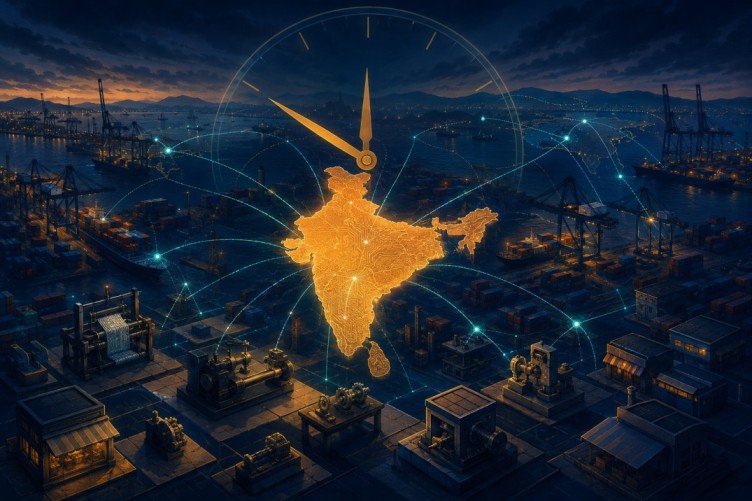
In 10 days, India’s most comprehensive trade deal in history goes live — and most small exporters still don’t know what hits them. Somewhere in Surat, a textile unit owner is processing orders the same way he did last year. In Tiruppur, a knitwear exporter is still quoting the same margins he built before duty structures changed. In Moradabad, a brass hardware manufacturer hasn’t yet spoken to a trade consultant about rules of origin compliance.
The India-UK Free Trade Agreement, years in negotiation and finally at the threshold of implementation, is not just a policy document. It is a live rewiring of commercial reality — and the gap between what this deal makes possible and what Indian businesses are actually prepared for may be the most consequential story no one is telling loudly enough.
This isn’t a moment to celebrate from a distance. It’s a moment to get close, get specific, and ask the harder question beneath the headline number: when the tariff walls come down, do Indian SMEs have the systems to walk through the door?
The Architecture of Unreadiness
Trade agreements don’t fail at the negotiating table. They fail in the warehouse, the invoice, the certificate of origin form filled out incorrectly at 11pm by someone who didn’t know the rules had changed. The India-UK FTA — which covers over 90% of tariff lines and unlocks preferential access for Indian goods ranging from apparel and footwear to processed food and engineering components — is structurally ambitious. But ambition at the policy layer doesn’t automatically translate into capability at the ground level, and India’s ground level is extraordinarily diverse.
The behavioural reality of India’s SME ecosystem is one of adaptive brilliance operating within deeply informal systems. Small exporters are extraordinarily resourceful. They build supply chains through relationships, not software. They navigate compliance through community knowledge, not formal training.
These are genuine strengths — until the rules of the game change faster than the informal networks can absorb. A free trade agreement of this scale introduces new compliance architecture — rules of origin requirements, bilateral cumulation norms, product-specific criteria — that requires a kind of systematic readiness most small businesses haven’t needed to develop until now.
The psychology here matters as much as the paperwork. For decades, Indian exporters operated in a world where market access was the ceiling. The question was always: can we get in? The FTA flips that ceiling into a floor. The question now becomes: can we scale once we’re in? That is a fundamentally different cognitive challenge, and it requires a different kind of confidence — one rooted not in hustle alone, but in process.
What ‘Made in India’ Means When the Doors Open
There is a quieter cultural shift embedded inside this trade deal that deserves its own attention. The “Made in India” identity has always carried a complex psychology — simultaneously a badge of pride and, in global premium markets, a signal that buyers still sometimes associate with cost efficiency rather than quality positioning. The UK market, with its sophisticated consumer base and deep appetite for artisanal, ethical, and origin-story products, is one of the most interesting testing grounds for whether that perception is shifting.
The data suggests it already is.
According to the UK’s Office for National Statistics, Indian-origin food and textile products in the UK retail segment have seen a compound annual growth rate of over 14% in the past three years, outpacing comparable imports from several Southeast Asian markets. That’s not a statistical footnote. That’s a market telling Indian producers something important — that when quality is consistent and storytelling is honest,
British consumers are ready to pay a premium for India’s supply. The FTA removes the tariff friction. What remains is the question of whether Indian exporters can build the brand infrastructure to match the commercial infrastructure the deal creates.
This is where the cultural lens becomes essential. Brand building requires a different relationship with time than trade deal readiness. The government can reduce tariffs in a negotiation room. It cannot, in the same room, install in an exporter the belief that his product deserves to be positioned as a premium offering rather than a low-cost alternative. That belief change is slower, more personal, and arguably more important than any clause in the agreement.
The Systems Gap No One Is Talking About
India’s export support ecosystem — DGFT, export promotion councils, MSME ministry schemes — is more developed than it was a decade ago. But the question is not whether the system exists. The question is whether it scales at the speed and specificity this moment demands. With implementation days away, the on-the-ground reality is that many SME exporters are learning about FTA compliance requirements through WhatsApp forwards and YouTube videos rather than structured government-industry handholding. That is not a criticism of individual initiative — it’s a systems observation about where the translation layer between policy and practice is still thin.
The UK side of this equation is worth watching too. British importers who source from India are already beginning to ask new questions of their supply chains — about ESG documentation, about traceability, about social compliance certifications. These requirements don’t come from the FTA text. They come from British retailer standards, from consumer advocacy pressure, from the broader architecture of what it means to sell into a developed market in 2025.
Indian exporters who treat this deal as purely a tariff story will leave the non-tariff advantage untouched. Those who understand that the real game is about readiness across dimensions — compliance, branding, quality systems, digital documentation — will be the ones who compound the opportunity.
There is a version of this story where ten years from now, we look back at the India-UK FTA as the inflection point that forced Indian SMEs to grow up systemically, not just commercially. Where the pressure of real market access created the conditions for genuine operational transformation. Where “Made in India” stopped being a cost signal and started being a confidence signal. That version is possible. But it doesn’t happen automatically.
The deal goes live in 10 days. The tariffs will fall on schedule. The question that will define the next decade isn’t whether India got a good deal — by most analytical accounts, it did. The question is whether the businesses that were supposed to benefit from it were ever truly brought into the room where the conversation was happening.
India has extraordinary commercial energy at the grassroots level. What it needs now is systems that meet that energy where it is — not just policy that assumes readiness exists because the opportunity does.
So here’s the question worth sitting with: if your business — or a business you know — isn’t ready for this deal in 10 days, what would it actually take to get ready, and who should have started that conversation a year ago?