Table of Contents
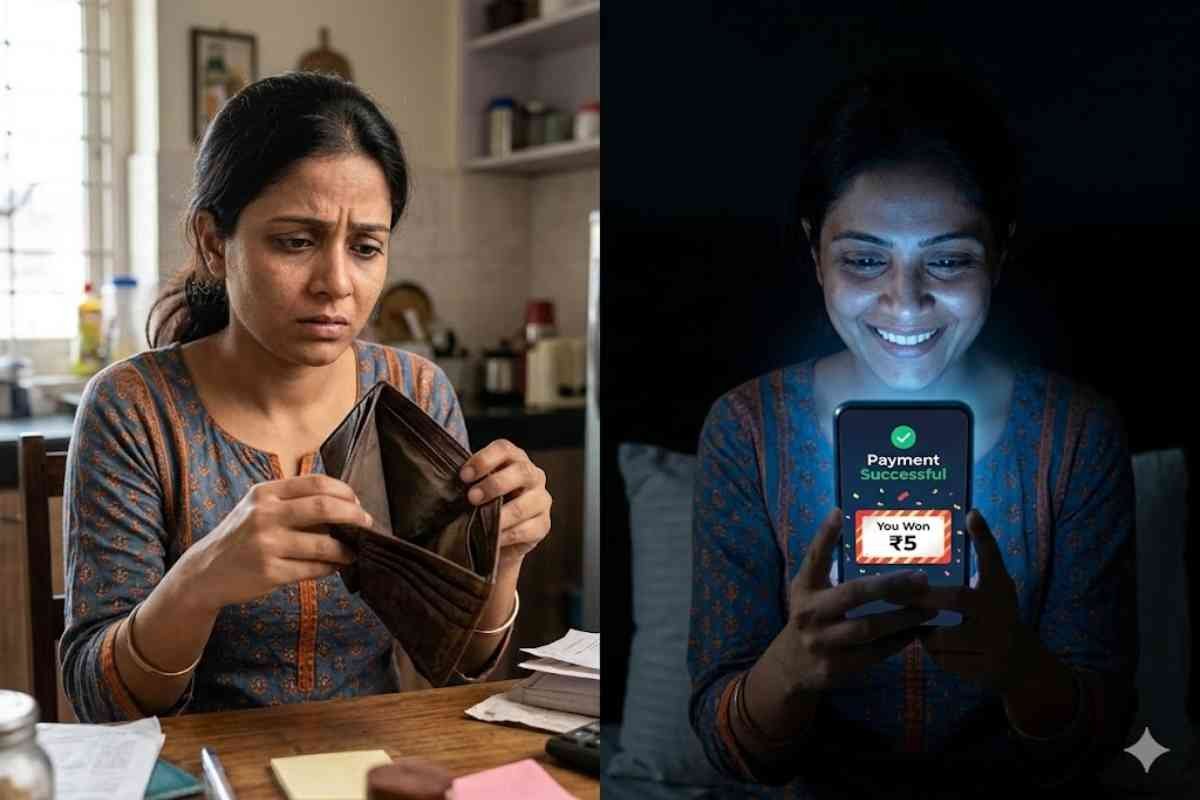
It’s the end of the month. You open your bank app, expecting to see a healthy balance, but instead, you are greeted by a number that makes your heart sink. You scroll through your transaction history, baffled. A coffee here, a subscription renewal there, a random midnight purchase. You consider yourself a rational, financially prudent Indian. You bargain with the sabzi wala for ten rupees. You switch off the lights when leaving a room. So, how is your money slipping away like sand through your fingers?
The answer doesn’t lie in your lack of willpower, but in the palm of your hand. The UPI apps we love—Google Pay, PhonePe, Paytm, CRED—are not merely neutral tools for moving money. They are sophisticated psychological engines, designed by some of the smartest behavioral economists and data scientists in the world. They are built on a foundation of “Dark Patterns” and “Nudges”—subtle design choices that hack your brain’s decision-making processes.
These apps have successfully gamified our finances, turning the solemn act of spending money into a dopamine-fueled video game. They have reduced the “pain of paying” to zero and replaced it with a colourful, rewarding, and frictionless experience. We are no longer just users; we are subjects in a massive, nationwide behavioral experiment. Here are the six hidden tricks your UPI apps use to manipulate your spending, and how you can spot them.
1. The ‘Scratch Card’ Slot Machine: Variable Ratio Schedules
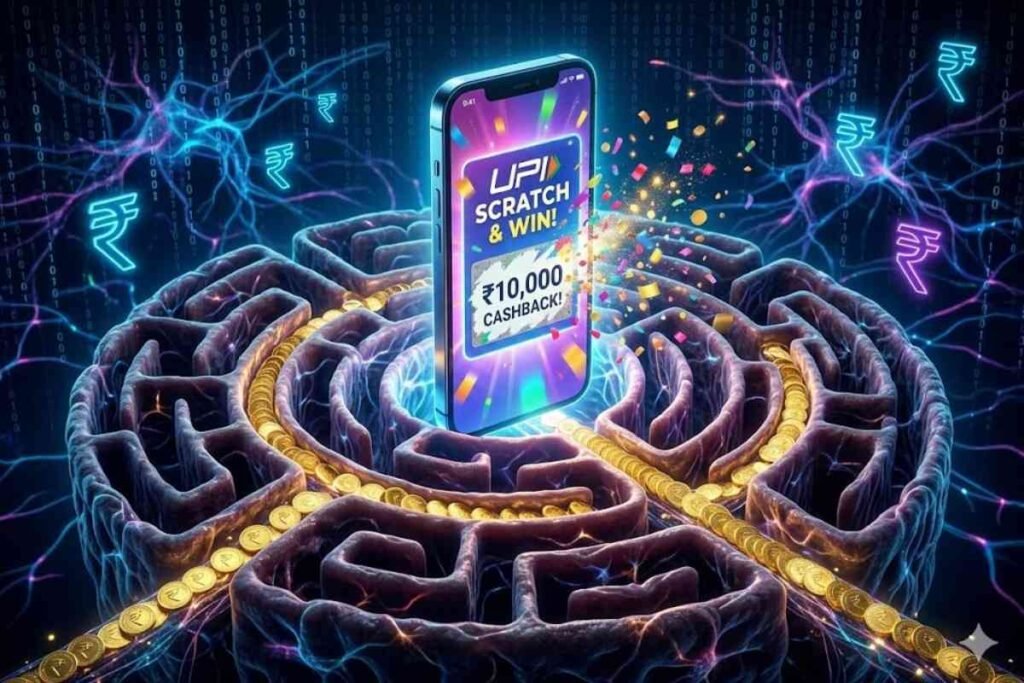
Remember the sheer excitement of scratching that digital card after a transaction? “Better luck next time,” it says, or perhaps, “You won ₹3.” You just transferred ₹5,000 for rent, and the app gave you ₹3. Logically, this is insulting. But psychologically, it is brilliant.
This utilizes a concept from behavioral psychology called the Variable Ratio Schedule of Reinforcement, famously demonstrated by B.F. Skinner. If a rat presses a lever and gets food every time, it presses it only when hungry. But if the rat gets food sometimes—randomly—it presses the lever obsessively.
UPI apps have turned payments into a slot machine. You don’t make a payment just to settle a bill; you do it for the chance of a reward. The unpredictability of the scratch card (will it be cashback? a discount voucher? nothing?) releases dopamine in the brain. This “gamification” keeps you hooked to the platform, encouraging you to use UPI for even the smallest transactions just to get another “spin” on the wheel.
2. The ‘Cashless Effect’: Removing the Pain of Payment
There is a visceral, physical pain associated with handing over a ₹500 note. You see it leave your wallet; you feel the loss. This is known in behavioral economics as the “Pain of Paying.” It acts as a natural brake on spending.
UPI apps are designed to anesthetize this pain. By replacing the physical handover of cash with a seamless swipe or a PIN entry, they decouple the consumption from the payment. This is the Cashless Effect. When you scan a QR code, your brain registers the interaction as a digital signal, not a loss of wealth.
Furthermore, the apps often hide your bank balance. To see how much money you have left, you usually have to click a separate button and enter a PIN. This “strategic obscurity” ensures that you focus on the ease of the transaction, not the depleting resources in your account. You are spending in a vacuum, detached from the reality of your budget.
3. The ‘Default’ Trap: Choice Architecture
Humans are cognitively lazy. When faced with a choice, we overwhelmingly prefer the path of least resistance. Behavioral economists call this the Status Quo Bias. UPI apps exploit this through “Choice Architecture.”
Have you noticed how the “Tip” option on food delivery apps (linked to UPI) often has a pre-selected amount? Or how “Auto-Pay” for subscriptions is often a pre-checked box? Or how the app defaults to your credit card (which earns them higher fees) rather than your bank account?
These defaults are not accidental. They are engineered to make you spend more or commit to recurring payments without active thought. To opt-out requires effort—unchecking a box, changing a setting. Most of us simply click “Pay” and move on, unknowingly agreeing to terms that drain our wallets.
4. Sensory Conditioning: The Pavlovian ‘Ding’
Why is the GPay screen blue? Why does PhonePe use that specific shade of purple? And why is the sound of a successful transaction so incredibly satisfying?
This is Sensory Marketing combined with Pavlovian Conditioning. The specific colours are chosen to evoke trust and calmness (blue is universally associated with stability). But the sound effects are the real trick. That crisp, musical “ding” or “ching” upon a successful payment is a positive reinforcement signal.
Just like Pavlov’s dogs learned to salivate at the sound of a bell, your brain has learned to associate that specific sound with the relief of a completed task and the pleasure of a purchase. It triggers a micro-moment of happiness. Over time, you begin to crave that sound. The app associates the act of spending money—which should be painful—with an auditory cue that signifies success and achievement.
5. Artificial Scarcity and The ‘FOMO’ Timer
“Offer expires in 2 hours.” “Only for you.” “3 friends just paid their electricity bill.”
If you see these notifications on your UPI or associated commerce apps, you are being targeted by the Scarcity Principle and Social Proof. Apps create a false sense of urgency to bypass your rational brain. When you see a countdown timer on a cashback offer or a discount coupon that is “vanishing soon,” your brain switches from logical analysis to a “Flight or Fight” mode (or in this case, “Buy or Cry”).
This Fear Of Missing Out (FOMO) compels you to make impulse purchases or pay bills earlier than necessary just to “lock in” a deal that saves you a negligible amount. The app creates a problem (the expiring offer) and positions the payment as the immediate solution.
6. The ‘Sunk Cost’ of Ecosystems: The Super-App Trap
Initially, UPI apps were just for payments. Now, they sell gold, insurance, mutual funds, and travel tickets. They have morphed into “Super Apps.” This leverages the Sunk Cost Fallacy and Convenience Bias.
Once you have linked your bank accounts, set up your billers, and grown comfortable with the interface (the sunk cost of your time and effort), the app wants to monetize you further. They nudge you to buy digital gold or insurance not because it’s the best financial product for you, but because it’s the easiest one to buy.
You might get a better insurance rate elsewhere, but the UPI app already has your data. “Just one tap to insure your trip,” it whispers. You pay for the convenience, often at the cost of a better deal or a more suitable product.
Conclusion: Reclaiming Your ‘Viveka’ (Wisdom)
Acknowledging these tricks doesn’t mean we should delete our apps and go back to stuffing cash in mattresses. UPI is a technological marvel that has empowered India. However, we must use it with viveka—discernment.
We need to recognize that the interface is not neutral. It is an active participant in our financial decisions, often lobbying against our best interests. The next time you feel the urge to scratch a card, or the rush of a “limited time offer,” pause. Take a breath. Remember that the “ding” is just a sound file, the blue screen is just pixels, and the “reward” is likely a few rupees designed to extract thousands from you.
By understanding the psychology of the machine, we can take back control of the man (or woman) using it. Let’s turn UPI back into what it was meant to be: a tool for our convenience, not a trap for our impulses.
Call to Action:
Have you ever fallen for the “Scratch Card” trap? Or found yourself spending more just because it’s so easy? Share your stories of “UPI impulse buys” in the comments below. Let’s help each other break the spell! Forward this article to that one friend who is addicted to cashback, and follow IndiLogs for more insights into the mind of the modern Indian consumer.