Table of Contents
India’s cities flood every July not because of rain — but because urbanisation has paved over every natural drain they had.
Just imagine: it’s the third week of July, and your city has received exactly the rainfall it receives every single year. Nothing unusual. Nothing historic. And yet your street looks like a river, your car is submerged to its door handles, and your local news anchor is calling it a “once-in-a-decade disaster.” Except it happened last year too. And the year before that. The water isn’t the surprise anymore — the collective amnesia about why it keeps happening is.
India’s urban flood crisis is not a weather story. It is a governance story. And the difference matters enormously.
The City That Forgot How to Drain
For centuries, Indian cities were built around water. Bangalore alone once had over 1,400 interconnected lakes that served as a cascading system of natural water management. Chennai’s urban landscape was threaded with rivers, wetlands, and canals that absorbed excess rainfall and recharged groundwater simultaneously. Hyderabad’s historic tanks were engineering marvels of passive flood control. These were not aesthetic features. They were infrastructure.
Then came rapid, unplanned urbanisation — and with it, concrete.
Between 1991 and 2011, India’s urban population grew by nearly 91 million people. Cities expanded outward and upward with extraordinary speed but without proportional investment in the systems that make cities livable. Lakes got encroached upon. Wetlands were classified as “wasteland” in revenue records and sold off for development. Stormwater drains were either never built, poorly maintained, or quietly converted into sewage channels — which then backed up the moment heavy rain hit.
The physical memory of how a city was supposed to manage water was systematically erased, one approved building plan at a time.
Smart Cities, Dumb Drains
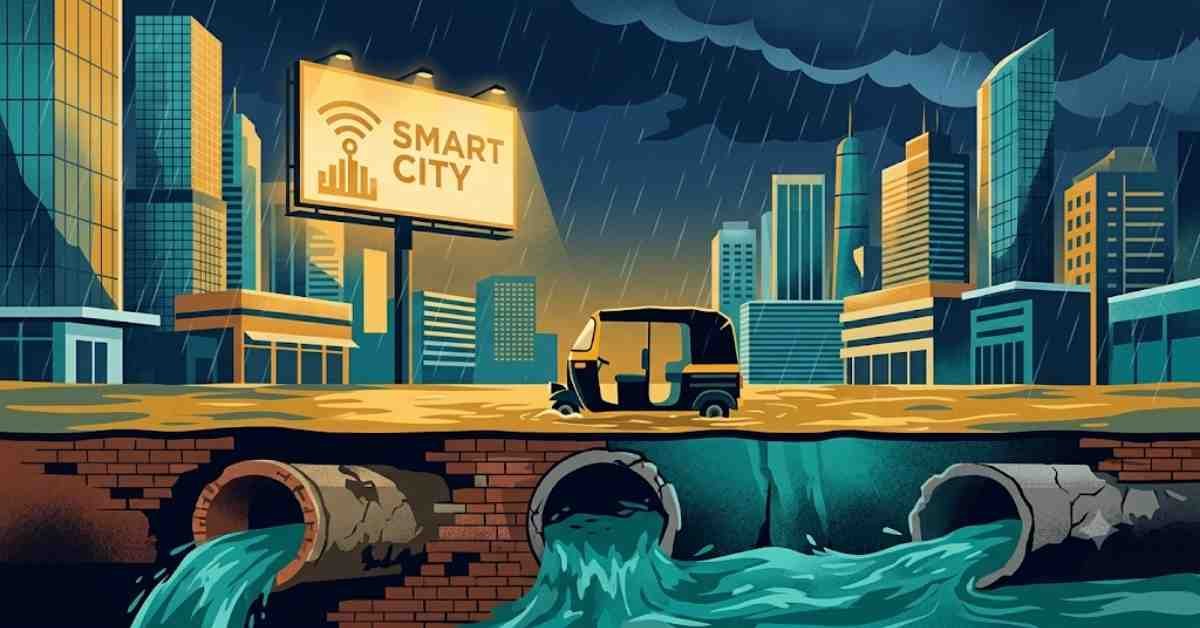
Here is where the policy contradiction becomes almost uncomfortable to examine. India launched the Smart Cities Mission in 2015 with an allocation of ₹98,000 crore, promising to transform 100 cities into technologically advanced, livable urban centres. The vision was genuinely ambitious — integrated command centres, sensor-based traffic management, digital citizen services.
And yet, the 2015 Chennai floods killed over 500 people and caused economic damage estimated at ₹1 lakh crore. The 2021 Hyderabad floods inundated the city’s IT corridor, the very symbol of its modern identity. Mumbai’s Hindmahim creek, which plays a critical role in managing floodwater, has seen encroachments that have reduced its width by nearly 60% over two decades, according to environmental assessments by the Bombay Environmental Action Group.
The gap between smart city ambition and ground reality is not a funding gap. It is a prioritisation gap.
Glamorous infrastructure — elevated metros, glass-fronted civic centres, LED-lit waterfronts — attracts ribbon-cutting ceremonies. Underground stormwater drains and restored urban wetlands do not. So political incentives consistently push investment toward the visible and away from the functional. The result is cities that look modern in press releases and flood in practice.
This is also a systems-thinking failure. Urban planning in India has historically operated in silos — the planning authority, the municipal corporation, the water board, and the environmental regulator each operate on separate mandates and separate budgets. Nobody owns the whole picture. When Bangalore floods, the Bruhat Bengaluru Mahanagara Palike points to the rain, the Karnataka Lake Conservation Authority points to encroachments it says it flagged years ago, and the developers point to their approved building permits. Everyone has a defence. Nobody has accountability.
What This Reveals About Urban India’s Bigger Problem
The flooding crisis is actually a mirror held up to a broader tension in how India thinks about growth. The dominant narrative of Indian urbanisation has been one of addition — add more towers, add more roads, add more flyovers. What has been consistently undervalued is the act of preservation and maintenance, which yields no headline but prevents enormous damage.
This is partly cultural and partly structural. In a country where visible construction signals progress, maintaining a stormwater drain or protecting a wetland feels unglamorous, even regressive. There is no groundbreaking ceremony for “we did not build on this floodplain.” There is no press conference for “we cleaned and maintained every drain in the catchment area before monsoon.”
The economic cost of this mindset is staggering. A 2018 report by the National Disaster Management Authority estimated that urban floods cause India losses of approximately ₹4.8 lakh crore every decade. That figure does not account for the informal economic losses — the daily wage workers who cannot reach job sites, the small businesses that flood and never fully recover, the health costs from post-flood waterborne disease outbreaks that disproportionately affect low-income neighbourhoods.
Flood risk in Indian cities is also deeply unequal. Wealthy residential areas typically sit on higher ground and benefit from whatever drainage infrastructure exists. It is almost always the low-income settlements, built on low-lying land near drainage channels because that land was cheapest, that bear the worst of each monsoon. The flood is not an act of nature. It is an act of accumulated planning decisions — and those decisions have a class dimension that rarely makes it into the policy conversation.
The technology to manage this exists. The engineering knowledge exists. Sponge city models from China, green infrastructure frameworks from the Netherlands, watershed restoration programmes from within India itself — solutions are not the missing piece.
What is missing is the political will to treat invisible infrastructure as seriously as visible infrastructure, to think across departmental silos, and to measure a city’s success not by its skyline but by whether it functions when it rains.
Every July, India’s cities offer the same proof that they have not yet made that shift.
So here is the question worth sitting with: if Indian cities flood on schedule every monsoon, and the causes are well-documented, and the solutions are well-understood — what exactly are we waiting for?