Table of Contents
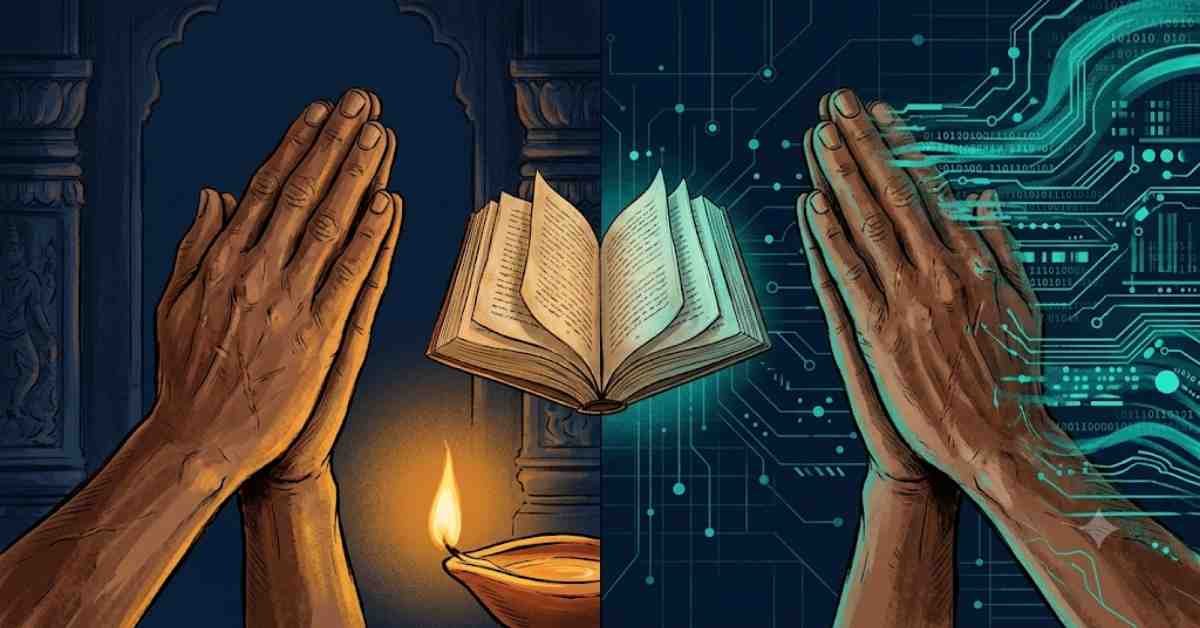
Searches for ‘Gita GPT’ jumped 83% last year. What happens when India’s oldest scripture meets its newest technology?
Picture a 24-year-old software engineer in Pune, sitting cross-legged on his apartment floor at 11 PM. His grandmother would have lit a diya and opened a worn, dog-eared copy of the Bhagavad Gita at this hour. He opens ChatGPT instead. He types: “I’m feeling lost in my career. What does Krishna actually mean in Chapter 3 when he talks about duty?” Within seconds, a response arrives — measured, contextualised, oddly comforting. He screenshots it and sends it to his mother. She reads it and says, surprisingly, “That’s actually right.”
This is not an isolated moment. It is a cultural inflection point quietly reshaping how hundreds of millions of Indians relate to their own spiritual heritage.
The Anatomy of a Spiritual Search
The 83% surge in searches for “Gita GPT” and related queries — documented across Google Trends data and app analytics from platforms like Bhagavad Gita AI and GitaGPT — is not really about technology. It is about access, anxiety, and the persistent human need for meaning delivered on demand.
For decades, the Bhagavad Gita was mediated by priests, pandits, grandparents, and the slow accumulation of lived exposure. Its 700 verses in Sanskrit required either devoted study or the luck of being born into a household where someone had already done that work. The emotional and interpretive labour was distributed across generations, communities, and temples. Now, that entire ecosystem is being compressed into a prompt box.
This is partly a post-pandemic phenomenon. The disruption of physical religious spaces between 2020 and 2022 forced millions of Indians online for spiritual content — and many never fully returned to the temple as their primary site of meaning-making. Yoga apps, meditation platforms, and devotional YouTube channels exploded in that period, and AI chatbots are simply the latest iteration of this digital spiritual turn.
There is also a deep generational friction at play. Young urban Indians often feel genuinely estranged from scriptures they were told were important but were rarely taught in any accessible way. AI bridges that gap without the social awkwardness of admitting ignorance to a priest or elder. It is a confessional booth that never judges your baseline knowledge.
When Ancient Texts Meet Algorithmic Interpretation
Here is where the cultural analysis becomes genuinely complicated, and where India’s situation differs meaningfully from how Western audiences engage with AI and religion.
The Bhagavad Gita is not simply a religious text in the Western sense of a fixed doctrinal scripture. It is a living conversation — one that has been debated, reinterpreted, and contested across centuries by figures as different as Adi Shankaracharya, Bal Gangadhar Tilak, and Mahatma Gandhi. Each brought a radically different reading to the same verses. That interpretive plurality is not a bug in Hindu philosophical tradition. It is the architecture. It is precisely what makes the Gita intellectually alive.
When an AI model answers a question about Chapter 2, Verse 47 — the famous “You have the right to work, but not to its fruits” — it typically aggregates across dominant interpretations. It tends toward a synthesis. And synthesis, however accurate, is not the same as encounter. The model cannot tell you which reading might shatter something open in you at 3 AM or which one would have made your grandfather weep. It gives you the distilled consensus, not the friction.
A 2023 survey conducted by the Indic Academy across 1,200 urban respondents aged 18–35 found that 61% of those who used AI tools to explore religious texts reported feeling “more informed” about their faith, but only 23% reported feeling “more connected” to it. That gap — between knowing and belonging — is where the real story lives.
The Democratisation Paradox
India’s government has been actively pushing digital access to religious and cultural heritage through initiatives like the Digital India Cultural Heritage programme and the Ministry of Culture’s digitisation of Sanskrit manuscripts. There is a legitimate and powerful argument that AI tools democratise knowledge that was historically gated behind caste, class, and geographical access to learned scholars. A Dalit student in a small town in Bihar can now engage with Vedantic philosophy without walking into a social structure that may have historically excluded her. That is not a trivial achievement.
But democratisation of information is not the same as democratisation of wisdom. The lived, embodied practice of Indian devotion — the smell of camphor, the rhythm of aarti, the way a particular shloka was sung by a specific person in a specific room — carries epistemological weight that text generation cannot replicate. Devotion in the Indian context has never been purely cognitive. It has always been sensory, communal, and inherited through proximity.
The risk is not that AI will replace the Gita. The risk is subtler: that it replaces the struggle with the Gita. That it short-circuits the productive confusion that forces genuine reflection. That it makes spiritual inquiry feel resolved when it has barely begun.
There is something both beautiful and quietly melancholic about a generation turning to machine intelligence to understand a text that was itself a dialogue — a conversation between a warrior paralysed by uncertainty and a divine teacher who refused to give him easy answers.
Krishna, famously, did not hand Arjuna a summary. He asked him to sit with the unbearable question longer than felt comfortable.
Perhaps the more honest question is not whether AI is changing how we pray — but whether ease was ever the point of prayer to begin with.
What do you think — is AI making ancient wisdom more accessible, or just more convenient? Tell us in the comments.