Table of Contents
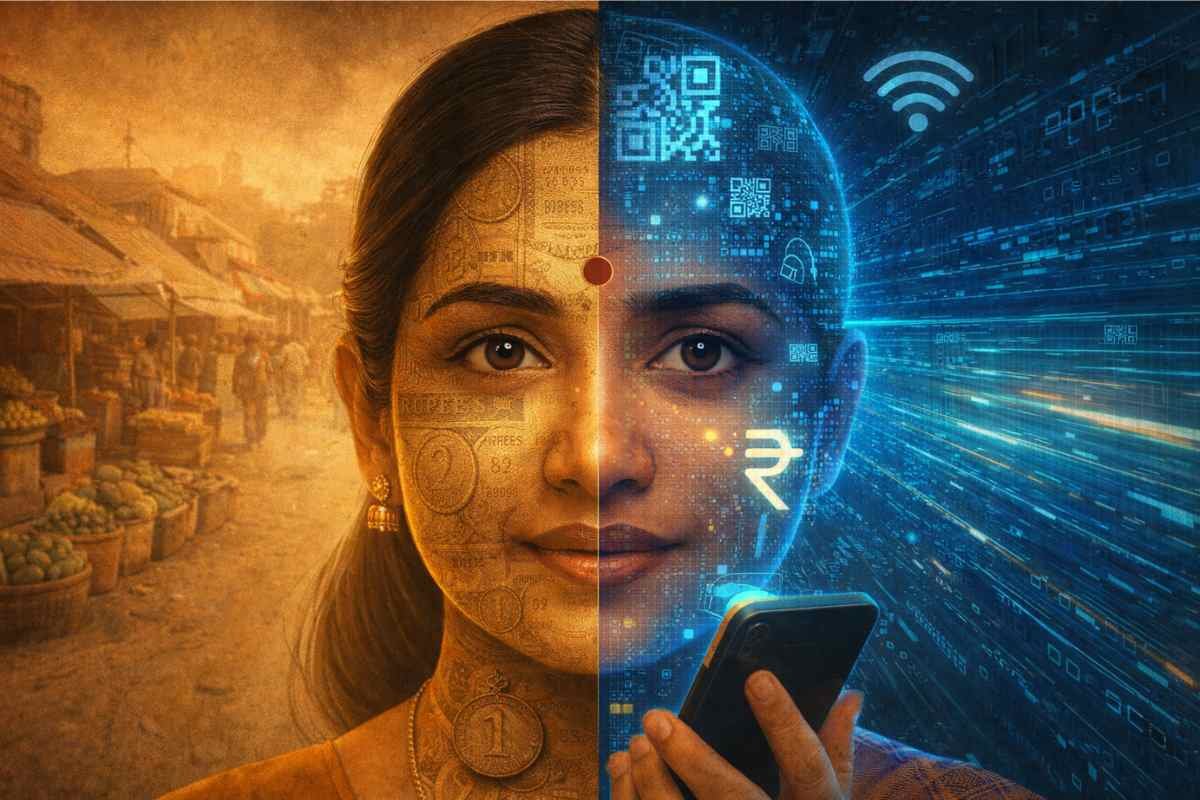
We tend to think of the Unified Payments Interface (UPI) merely as an app—a utility that sits on our phone screen between WhatsApp and Instagram. But to view it only as a tool is to underestimate it profoundly. UPI is a behavioral modifyier. It is a psychological filter through which we now view value, labor, patience, and generosity. In the span of a few short years, the satisfying ‘ding’ of a successful transaction has replaced the tactile rustle of currency notes, fundamentally altering the ancient relationship between the Indian mind and its money.
But how deep does the rabbit hole go? Have you simply adopted a convenient technology, or have you undergone a complete personality transplant? Have you lost the sanyam (discipline) of your parents? Have you developed new anxieties? To help you navigate this invisible transformation, we have designed a diagnostic self-assessment. These aren’t questions about your bank balance; they are questions about your soul in the digital age.
Grab a pen (or just use your mental notepad). Be honest. The results might surprise you.
The Diagnostic: 10 Questions to Audit Your Financial Soul
1. The “Pain of Paying” Threshold
Question: You are at a mall. You see a pair of shoes costing ₹4,500.
A) If you had to pay in cash, you would count the notes, feel a pinch of hesitation, and might even put them back. But with UPI, you tap and buy without a second thought.
B) The payment method makes no difference. ₹4,500 is ₹4,500, and you feel the same weight of the expense regardless of how you pay.
- The Insight: Behavioral economists call this the “Pain of Paying.” Cash activates the pain centers in the brain. UPI anesthetizes them. If you chose A, your brain has successfully dissociated the act of spending from the feeling of loss.
2. The “Chutta” Memory Test
Question: When was the last time you decided not to buy something small (like a chocolate or a newspaper) because you didn’t have change?
A) I can’t remember. I buy ₹5 chocolates with UPI all the time.
B) Last week. I still hesitate to use digital payments for tiny amounts because it feels silly or clutters my statement.
- The Insight: If you chose A, you have lost the “Friction Filter.” The lack of change was a natural brake on micro-spending. You have now entered the era of frictionless consumption, where no purchase is too small to be recorded on a server.
3. The Battery Panic Index
Question: You are out for dinner, and your phone battery drops to 5%. You have your wallet with cards and some cash. How do you feel?
A) Mildly annoyed, but I can pay with card or cash easily.
B) Pure, unadulterated panic. I feel like I’m about to be stranded on a desert island. I might even ask the waiter for a charger before ordering.
- The Insight: If you chose B, you have developed “Technological Dependency.” Your financial agency is no longer internal; it is tethered to a lithium-ion battery. You have become a cyborg—helpless without your digital limb.
4. The “Hisaab” (Accounting) Amnesia
Question: Without looking at your phone, can you tell me exactly how much money you spent yesterday, within a ₹100 margin of error?
A) No idea. It’s all a blur of small scans. I’d have to check my history.
B) Yes, roughly. I remember breaking a ₹500 note and what I bought with it.
- The Insight: If you chose A, you are suffering from “Transaction Amnesia.” Physical cash creates memory markers (the color of the note, the weight of the change). Digital transactions are ephemeral and don’t encode in our long-term memory, leading to a loss of financial awareness.
5. The Tipping Paradox
Question: You take an auto-rickshaw ride that costs ₹94. How do you pay?
A) I scan and pay exactly ₹94. Why would I pay more?
B) I scan and pay ₹100, or I pay ₹94 and hand over a ₹10 coin as a tip because I used to say “keep the change.”
- The Insight: If you chose A, UPI has killed your “Informal Generosity.” The friction of cash created a rounding-up economy that supported service workers. The precision of digital payments has made you mathematically efficient but socially stingier.
6. The “Udhaar” (Credit) Reflex
Question: A friend asks to borrow ₹500 for a minor expense. What is your immediate reaction?
A) I switch apps and transfer it in 10 seconds. It’s so easy, I don’t even ask why.
B) I pause. I ask why they need it. The process of giving money feels significant, so I treat it with some gravity.
- The Insight: If you chose A, you have “Gamified Lending.” The ease of the interface has lowered the social barrier to borrowing and lending, potentially blurring boundaries in your relationships and turning you into a walking ATM.
7. The Impulse Buy Factor
Question: How often do you buy things online (food, shopping) lying in bed at midnight?
A) Often. It’s just too easy. Fingerprint, done.
B) Rarely. I usually like to sleep on purchase decisions.
- The Insight: If you chose A, UPI has eroded your “Impulse Control.” The 1-click payment integration removes the “cooling off” period that existed when you had to fetch a wallet or type in card details, leading to lifestyle inflation.
8. The Negotiation Nuance
Question: You are bargaining with a street vendor. He agrees to a price of ₹380.
A) I pay ₹380 via UPI immediately.
B) I feel a weird urge to pay ₹350 in cash because “Cash is King” and might get me a better deal, or I feel awkward paying an exact bargained amount digitally.
- The Insight: If you chose A, you have accepted the “Digital Standard.” You no longer view cash as a negotiation lever. You value the speed of the transaction over the potential power of physical currency.
9. The Patience Test
Question: You scan a code, and the processing wheel spins for 10 seconds. How do you react?
A) I start getting anxious, maybe even angry. I tap the screen, switch data modes, and stare at the shopkeeper awkwardly.
B) I wait. It’s just 10 seconds. It takes longer to count cash anyway.
- The Insight: If you chose A, you have contracted “Digital Impatience.” UPI has recalibrated your internal clock. You now expect instant gratification in all things, and any delay feels like a systemic failure.
10. The Income Perception
Question: When your salary hits your account, do you check the SMS/Notification and feel rich?
A) I see the number, but it feels abstract. It feels like “points” to be managed, not a pile of wealth.
B) I feel a tangible sense of relief and resource acquisition.
- The Insight: If you chose A, you have undergone “Value Abstraction.” Money has ceased to be a resource and has become a metric. This dissociation can make it harder to save, as “saving” feels like just letting numbers sit there, rather than hoarding a physical resource.
The Diagnosis: Who Are You Now?
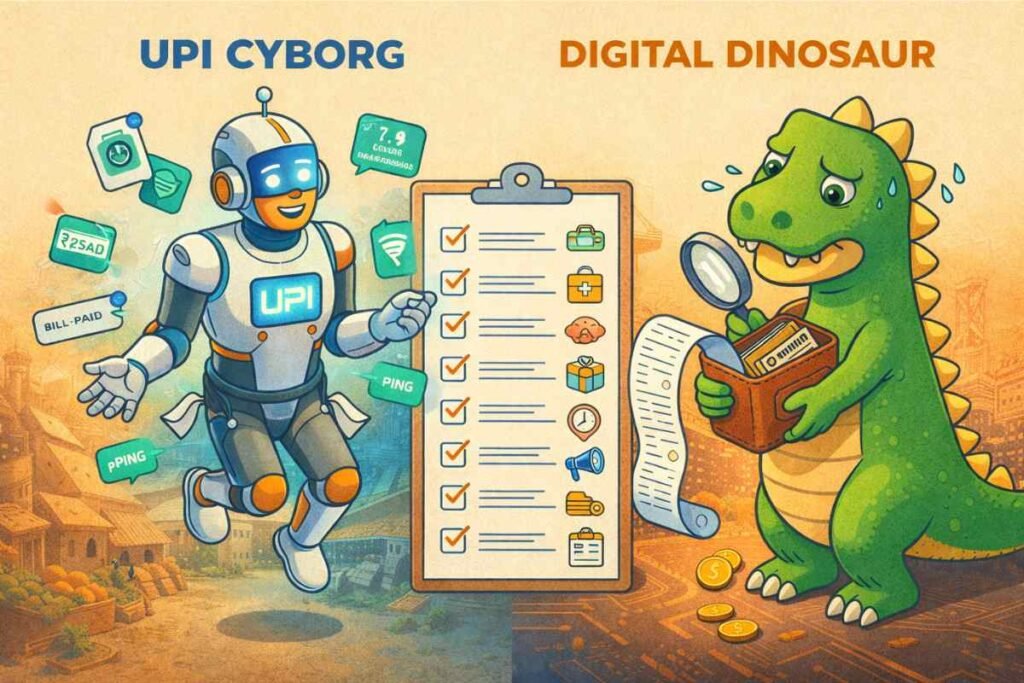
Mostly A’s: The UPI Cyborg
You have completely assimilated. You are efficient, modern, and frictionless. However, you are likely spending 20-30% more than you realize due to the “pain of paying” anesthesia. You have gained convenience but lost the visceral connection to the value of your labor.
- The Prescription: Try a “Cash-Only Weekend.” Withdraw ₹2,000 on Friday night and force yourself to survive on physical currency until Monday morning. Reconnect with the friction.
Mostly B’s: The Digital Dinosaur
You use UPI, but your soul is still analog. You are cautious, deliberate, and perhaps a bit slower at the checkout counter. You have retained the financial discipline of the older generation but are missing out on the fluidity of the modern economy.
- The Prescription: Loosen up. Set aside a small “digital allowance” (say, ₹5,000 a month) in a separate wallet app that you can spend guilt-free and friction-free. Enjoy the magic without risking the farm.
Mixed A’s and B’s: The Balanced Hybrid
Congratulations. You are walking the Madhya Marga (Middle Path). You use technology for convenience but haven’t let it completely override your financial instincts. You likely scan for big bills but might still carry cash for tips or small vendors. You are the ideal modern Indian consumer.
Conclusion: Reclaiming Your ‘Viveka’ (Wisdom)
The purpose of this audit isn’t to make you delete your apps. UPI is a superpower. But like any superpower, it requires control. The danger lies not in the technology, but in the sleepwalking. When we spend without feeling, we live without intention.
By recognizing these shifts—the loss of patience, the death of the tip, the amnesia of spending—we can choose to bring consciousness back to the transaction. We can choose to tip the extra ₹10. We can choose to pause before the midnight purchase. We can use the digital tool with an analog heart. That is the true Indian hustle: adapting to the future without losing the wisdom of the past.
Call to Action:
So, what’s your score? Are you a UPI Cyborg or a Digital Dinosaur? Share your results and your most embarrassing “UPI addiction” story in the comments below. Forward this test to your family group chat and watch the debate explode. Follow IndiLogs for more insights into the mind of modern India.