Table of Contents
Your seven-year-old just saw you tap your phone to pay for a week’s worth of groceries. Later that day, you tapped it again for a ₹20 ice cream. To your child’s developing brain, the action was identical. The magic wand was waved, and the wish was granted. How, in this world of frictionless, invisible money, are we supposed to teach them the most fundamental financial lesson our parents taught us: the difference in value between that ₹20 and the ₹7,000 grocery bill?
The old curriculum is dead. The gullak (piggy bank), the crisp pocket money note, the painful act of handing over cash—these were the pillars of our financial education. They are now museum pieces. We are the first generation of Indian parents tasked with a monumental challenge: teaching the ancient wisdom of money to children who may never touch it. This is not a drill. It’s a new parenting dharma, and it requires a brand-new set of financial sanskar (teachings).
The Great Disconnect: When Money Becomes a Video Game Score
The core problem is abstraction. For us, money was a thing. For our children, it’s a number. And numbers, as they know from their video games, can go up and down with taps on a screen. Our parental duty is no longer just to provide; it’s to make the abstract, concrete. It’s to reconnect the magical number on the screen to the real-world concepts of work, value, and scarcity. The old tools are gone, so we must invent new ones. Here are ten new lessons for the UPI generation.
The New Curriculum: 10 Lessons for a Cashless Childhood
Lesson 1: The ‘Source of the River’ Talk
- Old Way: “Money doesn’t grow on trees.”
- New Challenge: Money seems to magically appear in the phone.
- New Lesson: Make the source visible. Show them the SMS alert when your salary is credited. Say, “This is the money the family has to use for the whole month because Mama/Papa worked.” Frame it as a finite resource, a ‘tank’ of water that has to last.
Lesson 2: The ‘Why’ of Value
- Old Way: A ₹100 note felt bigger and more important than a ₹10 coin.
- New Challenge: ₹100 and ₹10,000 are just different numbers on a screen, paid for with the same tap.
- New Lesson: Translate numbers into effort. Say, “This toy costs ₹500. That is how much Papa earns for working for half a day.” Or, “This ₹50 ice cream costs the same as two kilos of potatoes for our dinner.” Connect the abstract number to a tangible unit of work or an alternative purchase.
Lesson 3: The Digital Envelope System
- Old Way: Physical envelopes for “Groceries,” “Fees,” “Fun.” When an envelope was empty, the spending stopped.
- New Challenge: All money is in one giant, seemingly bottomless digital pool.
- New Lesson: Create digital envelopes with them. Sit down with a notebook or a simple spreadsheet at the start of the month. Allocate the family budget together. “Okay, we have ₹10,000 for food. Let’s track how much we are spending on Swiggy vs. groceries.” This makes them a participant in the family’s financial planning.
Lesson 4: The 3-Jar Rule (Physical Edition)
- Old Way: The gullak taught saving.
- New Challenge: Digital savings are invisible and feel less rewarding.
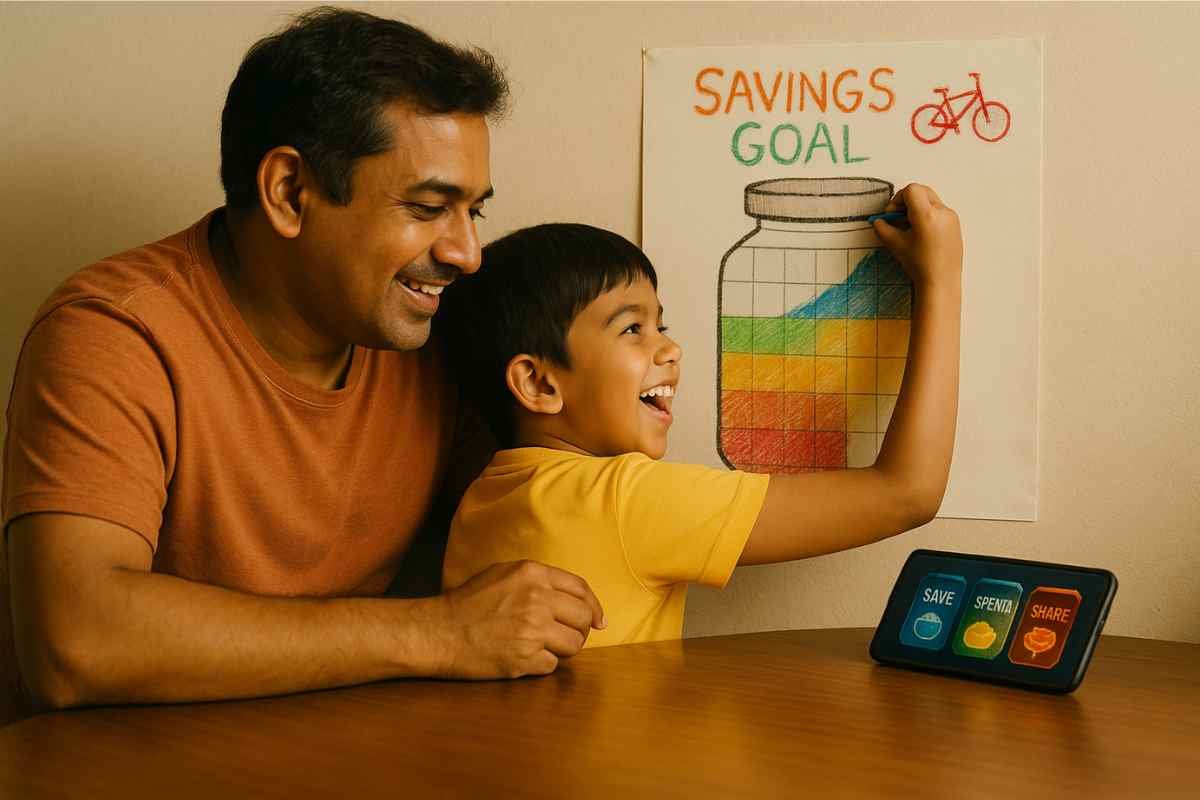
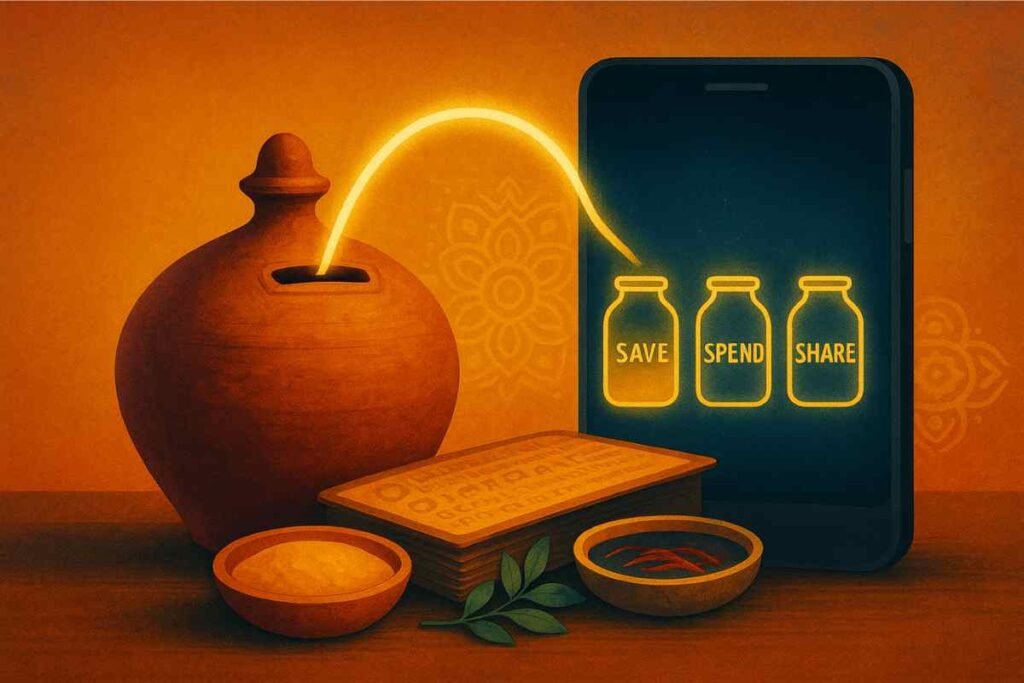
- New Lesson: Re-introduce the physical. Even if you give them a digital allowance, insist they divide it physically using three jars or boxes: SAVE, SPEND, and SHARE. If you give them ₹100 a month, have them write “₹50 – SPEND,” “₹40 – SAVE,” “₹10 – SHARE” on slips of paper and put them in the jars. It re-creates a tactile sense of allocation.
Lesson 5: Re-Inventing the ‘Pain of Paying’
- Old Way: Handing over cash hurt a little, which was a good thing.
- New Challenge: Tapping a phone is painless and emotionally detached.
- New Lesson: Make them the keeper of the budget. When at the toy store, instead of you just tapping, say, “Okay, our ‘Toy’ budget for this month is ₹1,000. This toy is ₹700. If we buy it, we have ₹300 left. You tell me if it’s worth it.” Make them verbalize the deduction. This forces them to consciously process the “loss.”
Lesson 6: The ‘Earning, Not Getting’ Principle
- Old Way: Pocket money was often tied to chores.
- New Challenge: A UPI transfer feels like a gift, not something earned.
- New Lesson: Create a clear ‘Earning Menu’. For younger kids: “Tidying your room = ₹10.” For older kids: “Helping with a big project = ₹100.” Then, when you make the UPI transfer, add a note: “For helping with the Diwali cleaning.” This directly links the digital money to their effort.
Lesson 7: The Digital Danger Talk
- Old Way: The danger was losing a wallet or having it stolen.
- New Challenge: The dangers are invisible: scams, phishing links, accidental in-app purchases.
- New Lesson: Frame digital security as the new “locking the door.” Just as you teach them not to talk to strangers, teach them the rules of the digital street: “Never share a PIN,” “Don’t click on links from unknown numbers,” “Always ask before downloading a new game.”
Lesson 8: The Joy of the ‘Saving Goal’ Chart
- Old Way: Watching the gullak get heavier was the motivation.
- New Challenge: Digital savings are just a number that goes up, which is less motivating.
- New Lesson: Make the goal visual. If your child is saving for a ₹2,000 video game, create a chart on the wall. A big thermometer-style drawing. Every time they save another ₹100, they get to colour in a new section. It provides the tangible sense of progress that the app screen lacks.
Lesson 9: The ‘Share’ Jar in Action
- Old Way: Putting a coin in the temple hundi or giving it to a person in need.
- New Challenge: Charity is also becoming digital and abstract.
- New Lesson: Make it a family activity. At the end of the month, count the money in their “SHARE” jar. Research a cause together. Say, “With your ₹100, we can help this animal shelter buy food for a puppy for three days.” Then, let them press the ‘Pay’ button on the UPI transaction to make the donation. This teaches them that money is also a tool for doing good.
Lesson 10: The 24-Hour Cooling-Off Period
- Old Way: Buying something often required a separate trip, giving you time to think.
- New Challenge: Impulse buys are just a click away.
- New Lesson: Introduce the “Family Cart Rule.” For any non-essential online purchase over a certain amount, the rule is you put it in the cart, but no one is allowed to buy it for 24 hours. This teaches them the crucial skill of separating “I want it” from “I want it right now,” the very essence of delayed gratification.
Conclusion: The New Financial Guru is You
Parenting in the digital age is not for the faint of heart. We are the bridge between the physical world of our childhood and the abstract world of our children’s future. The old financial sanskar won’t be passed down automatically; it must be actively, creatively, and patiently taught. By using these new lessons, we are not just teaching our children about money. We are teaching them about discipline (sanyam), about value, and about their place in the world. We are giving them the wisdom to master the tools that will shape their lives.
Call to Action:
What are the biggest challenges you face teaching your kids about money in the UPI era? What creative solutions have you found? This is a new frontier for all of us. Share your wisdom and your struggles in the comments below. Let’s build this new curriculum together. Follow IndiLogs for more conversations on raising a mindful new generation of Indians.