Table of Contents
The server crashed at 2 AM, an hour before the big festive sale went live. In the war room, panic was a thick, tangible thing. But then, the legend was born. The founder, armed with three Red Bulls, a Stack Overflow thread, and a piece of code held together by duct tape and a prayer, bypassed the corrupted module and got the system back online with seconds to spare. The sale was a roaring success. This story became part of the company’s founding myth—a testament to its grit, its resourcefulness, its spirit of jugaad.
Fast forward two years. The company is ten times bigger. The “server crash” isn’t a rare crisis; it’s a weekly occurrence. The team is in a perpetual state of firefighting, and the same heroic founder is now a haggard, exhausted bottleneck. The very superpower that saved the company in its infancy is now strangling its growth. This is the great, painful, and necessary identity crisis facing almost every successful Indian startup: the transition from a culture of heroic improvisation to one of disciplined systematization. It is a battle for the very soul of the company.
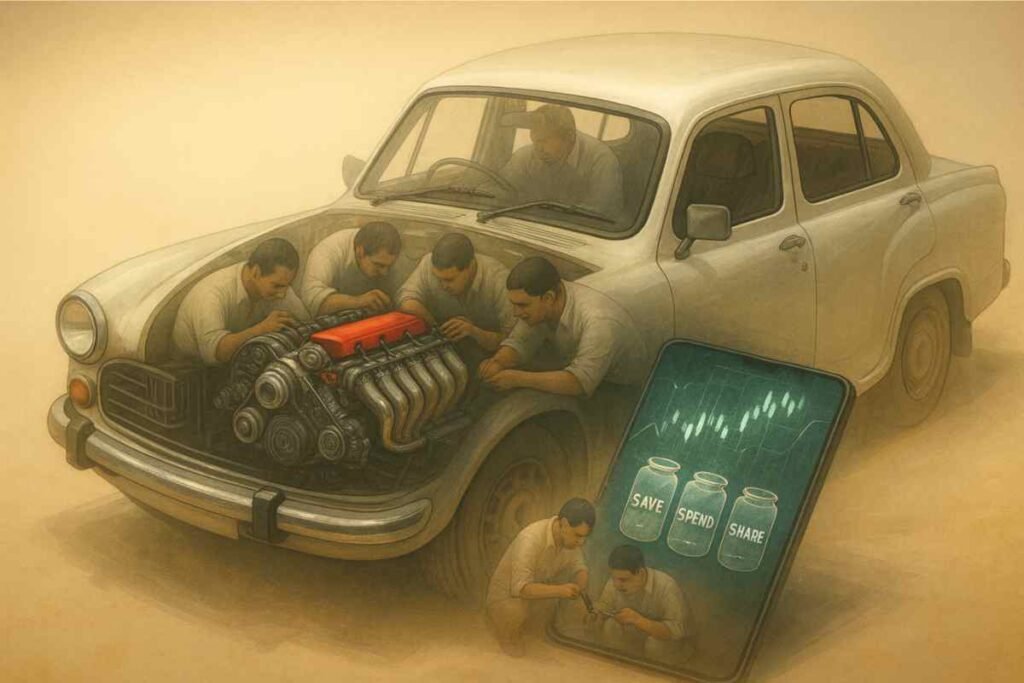
The Cult of the Clever Hack: Why We Worship Jugaad
Jugaad is more than just a word; it’s a core part of our national identity. It’s the spirit of making something from nothing, of finding a clever way around an obstacle, of refusing to be constrained by a lack of resources. In the early days of a startup, jugaad is not just a good thing; it is the only thing.
It empowers a small, scrappy team to move at lightning speed. There are no rulebooks, no SOPs, just a shared mission and the freedom to solve problems on the fly. It rewards quick thinking, builds a “we’re-in-this-together” camaraderie, and fosters a culture where the best idea, not the approved process, wins. The founder who is the master of jugaad is the hero, the ultimate problem-solver.
The Scaling Wall: When the Superpower Becomes a Liability
This beautiful, chaotic system works perfectly, right up until the moment it doesn’t. The transition from a 20-person team to a 200-person organization is the wall where jugaad-driven cultures often crash.
- It Doesn’t Scale: The hero founder cannot be in ten places at once. The clever hack that one engineer knows is useless if they’re on vacation. Knowledge remains siloed in people’s heads, not embedded in the organization’s systems.
- It’s Unpredictable: A business built on jugaad cannot deliver a consistent customer experience. The quality of the output depends entirely on which hero is fighting the fire that day. This unpredictability kills customer trust.
- It Kills Efficiency: A culture of constant firefighting is exhausting and inefficient. The team spends all its energy fixing preventable problems instead of building the future. They are forever dealing with the urgent, never the important.
The Resistance: “We’re Becoming a Corporate Bureaucracy!”
The moment a founder suggests implementing a “process”—be it a ticketing system, a standardized onboarding checklist, or a formal code review—the resistance is immediate and fierce.
For the founder, it’s an identity crisis. Their value was always in being the master fixer. To build a system that no longer requires their daily heroic intervention feels like making themselves redundant. They succeeded through intuitive, flexible problem-solving; this new world of “bureaucracy” feels alien and constraining, a betrayal of the scrappy spirit that made them successful.
For the early employees, it feels like a loss of culture. They were the original mavericks who thrived in the chaos. The new rules, the checklists, the standardization—it all feels like the “corporate” world they ran away from. It feels like the “fun” is over, replaced by a rigid, soulless machine. This resistance is the single greatest hurdle to scaling.
The Hybrid Path: Freedom Within a Framework
The goal is not to kill the spirit of jugaad, but to channel its power effectively. The most successful scaling startups don’t choose process over jugaad; they find a hybrid model. They build a framework of process around the things that must be predictable, creating the stability that allows for creative improvisation where it matters most.
- Systematize the Mundane: Automate and process-orient the 80% of your business that is repeatable: customer billing, employee onboarding, financial reporting, server deployment. This isn’t bureaucracy; it’s operational sanity. It frees up your team’s most valuable resource—their brainpower.
- Unleash Jugaad on the Novel: With the mundane handled, the team can now apply its creative, improvisational energy to the 20% of problems that are new and complex: cracking a new market, designing an innovative product feature, or responding to a sudden competitive threat.
- Build “Guardrails, Not Cages”: A good process is not a rigid cage; it’s a set of guardrails on a highway. It doesn’t tell you how to drive, but it prevents you from careening off a cliff. It provides a safe space within which creativity and speed can flourish.
The transition from a jugaad-first to a process-driven company is the startup’s journey from adolescence to adulthood. It can be awkward and painful. It involves letting go of old identities and embracing a new, more mature way of operating. The founder must evolve from being the company’s best problem-solver to being the architect of a problem-solving system. It’s the hardest work they will ever do, but it’s the only way to build an organization that is not just a legendary startup, but a lasting institution.
Has your company struggled with the Jugaad vs. Process tension? How do you strike the right balance? Share your experiences in the comments!