Table of Contents
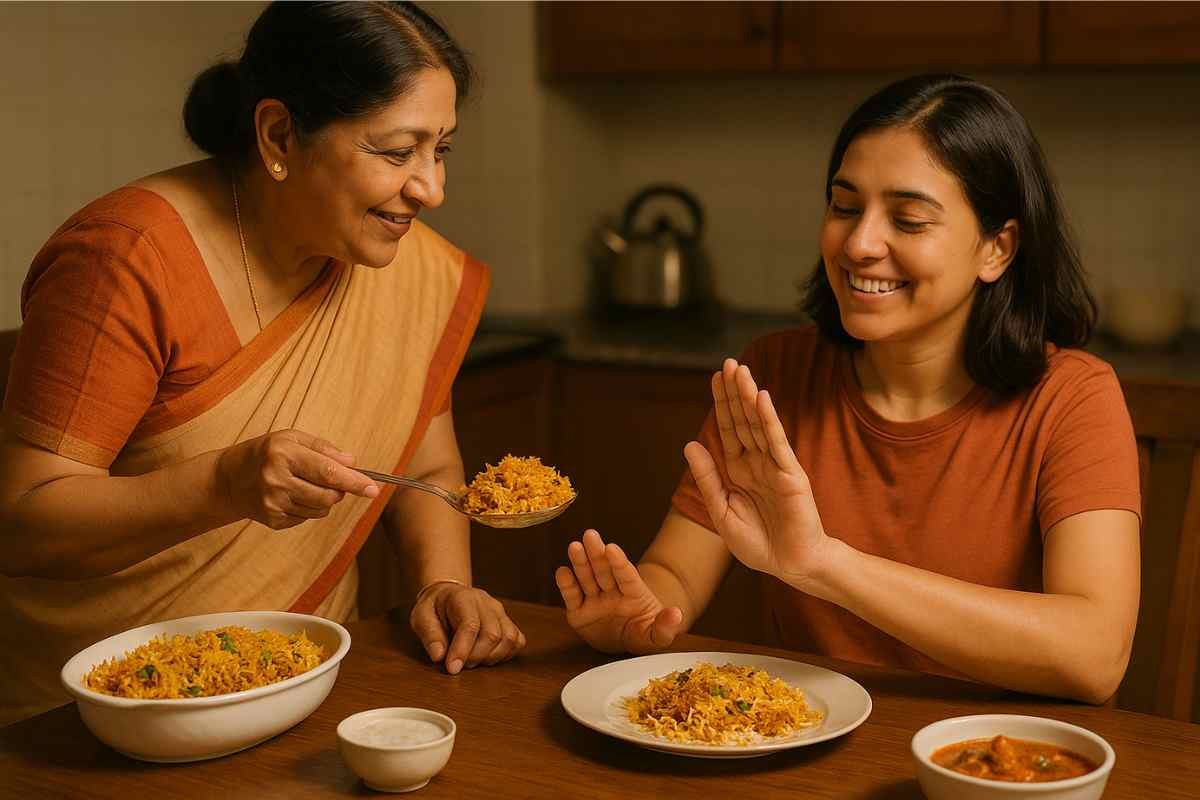
In India, “No, thank you, I’m full” is rarely interpreted as a statement of physiological satiety. It is usually heard as, “I am being polite, please overcome my resistance with emotional blackmail.”
We live in a culture where food is the primary currency of love. The size of the serving spoon is directly proportional to the affection of the host. Refusing a second helping of biryani can be seen as a personal rejection of the cook, the family, and the hospitality of the entire lineage. For health-conscious Indians, those managing medical conditions, or anyone simply trying to avoid the post-30 metabolic slump, this creates a unique battlefield. How do you maintain your health goals without insulting your Bua ji, offending your host, or triggering a family inquiry into whether you think you’ve become “too posh” for homemade ladoos?
It’s time to stop viewing this as a battle of willpower and start viewing it as a diplomatic mission. Here are five strategies to navigate the calorie-laden minefield of Indian hospitality while keeping your health (and relationships) intact.
1. The “Thoda” Technique: The Art of the Micro-Serving
In the Indian context, an empty plate is a distress signal that summons a refill. A flat refusal (“I don’t want any”) triggers the “Why? Are you sick? Is the food bad?” inquisition.
- The Strategy: Never leave your plate empty. Maintain a “defensive layer” of food. When offered more, don’t say “No.” Say, “Bus thoda sa” (Just a tiny bit).
- Why it Works: You are accepting the offering (validating the host) but controlling the volume. Take a teaspoon of the halwa, praise it profusely, and eat it slowly. You satisfy the cultural ritual of acceptance without consuming the caloric equivalent of a small planet. By keeping food on your plate, you signal abundance, preventing the host from swooping in with a ladle of “love.”
2. The “Doctor’s Orders” Shield (Because “Diet” is a Dirty Word)
If you say you are “dieting” or “watching your weight” at an Indian family gathering, prepare for an onslaught of unsolicited advice: “Ghee is good for bones!” or “You have become too weak!” (Body-shaming in India swings wildly between “you’ve gained weight” and “you look sick” with very little middle ground).
- The Strategy: Externalize the authority. Don’t make it about your vanity; make it about your vitality. “I would love to, but my doctor has strictly restricted sugar/oil/carbs.”
- Why it Works: Indian families may argue with you, but they rarely argue with a hypothetical medical professional. It shifts the narrative from “I am rejecting your food” to “I am adhering to a medical necessity.” This is particularly useful for those managing diabetes or heart health who often face the dangerous “just one sweet won’t hurt” pressure.
3. The “Seva” Distraction: Serve to Survive
Festivals and weddings are the high-risk zones of force-feeding. If you are sitting down, you are a target.
- The Strategy: Get up and help. Pick up a jug of water, help clear plates, or serve the starters.
- Why it Works: It is physically impossible to stuff your face when your hands are full of serving spoons. Plus, in the Indian cultural matrix, “Seva” (service) ranks higher than eating. You transition from being the “fussy eater” to the “helpful, sanskari family member.” It’s a brilliant sleight of hand that keeps you active and away from the buffet line.
4. Decouple Food from Affection: The Psychological Shift
This is the internal work. We are conditioned to believe that eating someone’s food is the only way to accept their love. We need to break this equation, not just for ourselves, but to teach our children that bodily autonomy matters more than pleasing a host.
- The Strategy: Validating the person without consuming the product. Use your words to replace the act of eating. “Maasi, seeing you is the real treat,” or “The aroma is nostalgic, I’m so full but I’m taking some home for later.”
- Why it Works: It addresses the host’s emotional need for validation. Often, the pressure to feed comes from a desire to be appreciated. Give them the appreciation verbally and enthusiastically, and the pressure to prove it gastronomically often subsides.
5. The “Slow-Mo” Eater Defense
Indian meals are often rapid-fire affairs. If you eat at a normal pace, your plate will be replenished three times before you realize what happened.
- The Strategy: Be the slowest eater at the table. Chew thoroughly. Put your fork down between bites. Engage in conversation. Drink water.
- Why it Works: The “refill hawks” look for empty space on a plate. If your plate looks full for 20 minutes because you are mindfully savoring the same roti, they will eventually move on to an easier target. This allows you to participate in the communal dining experience—which is the true heart of the culture—without overeating.
Breaking the Cycle
Our culture’s obsession with feeding is rooted in a history of scarcity where food was the ultimate gift. But in an era of sedentary lifestyles and lifestyle diseases, this expression of love has become a health hazard.
It is possible to cherish the culinary heritage of India—the spices, the flavors, the communal joy—without succumbing to the pressure of excess. By setting boundaries with humor, grace, and firmness, we aren’t just protecting our waistlines; we are redefining what a healthy Indian lifestyle looks like. We are teaching the next generation that you can love your culture and listen to your body at the same time.
How do you handle the “Just one more puri!” pressure? Share your best excuses and strategies in the comments below! And if this guide saved you from a future food coma, please share it with your family groups on WhatsApp!