Table of Contents
Have you ever tapped your phone to pay ₹700 for a meal and felt absolutely nothing, but then felt a sharp pang of regret handing over a crisp ₹500 note for groceries? Or have you found yourself getting strangely impatient in the five seconds it takes for a payment to process? If so, you’re not alone. You are a subject in the largest, most rapid, and most fascinating psychological experiment in modern Indian history.
The mass shift from physical cash to digital payments has done more than change our economy; it has fundamentally rewired our brains. We consulted with behavioral psychologists to decode the six most profound changes they’ve observed in Indians who have stopped using cash. This isn’t just about technology; it’s about the very architecture of our decision-making.
The Psychological Shift: From Tangible Value to Abstract Numbers
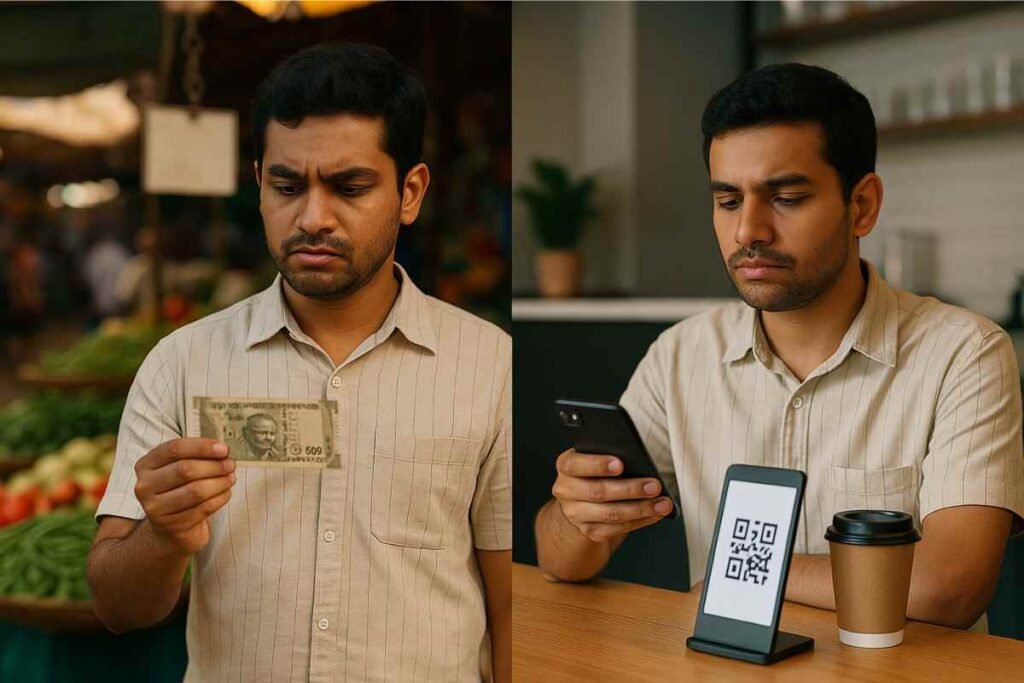
Before we dive in, it’s crucial to understand the core principle at play. Cash is physical. It’s dirty, it’s tangible, it has weight. Our brains evolved over millennia to understand the value of physical objects. Digital money, on the other hand, is an abstract concept—just numbers on a screen. This shift from the concrete to the abstract is the source of all the behavioral changes that follow.
As Dr. Rohan Mehra, a cognitive psychologist who studies the intersection of technology and human behaviour, puts it, “We are witnessing a mass cognitive offloading of financial self-regulation. The physical friction of cash acted as a natural speed bump for our spending impulses. By removing that friction, we’ve put our brains into a new, faster, and more vulnerable operating mode.”
Here are the six major changes psychologists like Dr. Mehra are seeing every day.
1. The Disappearance of ‘Payment Pain’
The Observation: The most significant change is the near-total elimination of what psychologists call “pain of payment.” Handing over physical cash triggers a minor but real psychological pain, a sense of loss. This pain is a powerful, subconscious budgeting tool.
The Cashless Behaviour: With UPI, this pain is gone. A tap is a low-effort, emotionally neutral action. It feels less like a loss and more like a simple interaction with a device. This is why you feel less guilt spending ₹1,000 via a tap than you do breaking two ₹500 notes.
Dr. Mehra’s Insight: “The neuro-pathway for spending is now closer to ‘liking’ a photo on Instagram than it is to the old pathway of a physical sacrifice. This emotional detachment leads directly to higher frequency and volume of spending, especially on non-essential items.”
2. The Fog of Financial Amnesia
The Observation: People who primarily use digital payments have a much poorer memory of their recent spending. Cash creates stronger memory markers: the ATM you visited, the specific notes you used, the change you received.
The Cashless Behaviour: At the end of the day, a cash user might remember, “I spent about ₹300.” A UPI user often has no intuitive sense of their daily total. Their spending is a blur of dozens of small, forgotten transactions. They have to actively check their app history to understand their financial activity, a step most people don’t take.
Dr. Mehra’s Insight: “This is a classic case of value abstraction. Because the amounts are just numbers and not tied to a physical object, they don’t encode into our episodic memory with the same strength. It leads to a constant, low-level financial disorientation.”
3. The Broken Budgeting Instinct
The Observation: The intuitive, “feel-based” budgeting we learned as children is breaking down. The physical limit of the cash in your wallet was a powerful, tangible budget. When it was gone, it was gone.
The Cashless Behaviour: A digital balance doesn’t feel finite in the same way. It’s just a large number connected to your entire life savings. The mental barrier between spending money and savings has become dangerously thin. There’s no clear “stop” signal, which makes it harder to control impulse buys. The gullak (piggy bank) taught us about scarcity; the UPI app teaches us about flow.
Dr. Mehra’s Insight: “We’ve lost our physical anchors for financial planning. Without the visual and tactile feedback of a thinning wallet, our brain’s natural self-regulation system struggles to activate. It’s like driving a car without a fuel gauge, only a warning light that comes on when you’re already empty.”
4. The Generosity Glitch
The Observation: While large, formal donations may have become easier, casual, spontaneous generosity has taken a significant hit. The culture of “keep the change” was a cornerstone of India’s informal tipping economy.
The Cashless Behaviour: UPI’s precision eliminates the opportunity for this casual generosity. Tipping digitally requires a conscious, separate action, which introduces friction. This has led to a noticeable decline in small gratuities for service workers. At the same time, lending money to friends has become frictionless, creating new social pressures.
Dr. Mehra’s Insight: “The nature of generosity has changed. It has become more deliberate and less spontaneous. The cashless system makes it easier to fulfill a planned social obligation (like sending a wedding gift) but harder to perform a small, anonymous act of kindness (like tipping).”
5. The Rise of the Immediacy Bias
The Observation: The instant gratification of a UPI payment has shortened our patience for all other processes. We are becoming conditioned to expect immediate resolutions in all aspects of life.
The Cashless Behaviour: This manifests as the “Awkward Pause Economy,” where the 3-5 second wait for a payment confirmation feels like an eternity. This impatience spills over into other areas, leading to frustration with delivery times, customer service queues, and any process that doesn’t offer the same instant finality as a GPay beep.
Dr. Mehra’s Insight: “This is a textbook case of conditioning. The consistent, rapid reward cycle of UPI payments recalibrates our brain’s internal clock. We are developing a societal-level intolerance for any kind of delay or friction, which can increase overall stress and anxiety levels.”
6. The Socialization of the Rupee
The Observation: Money has shed its traditional privacy and has become a medium of social communication.
The Cashless Behaviour: This is the most uniquely Indian adaptation. People are sharing payment screenshots as status symbols (“the payment flex”), using ₹1 transfers to send jokes or test connections, and using the “Request Money” feature as a casual way to interact with friends. Money is no longer just for commerce; it’s for conversation.
Dr. Mehra’s Insight: “In a collectivist culture like India’s, it was inevitable that a powerful tool like UPI would be co-opted for social signaling and relationship maintenance. The transaction has been imbued with a social meaning that goes far beyond its economic value. It’s a fascinating example of technology adapting to culture, not just the other way around.”
Conclusion: The New Indian Mind
The move to a cashless society is not just a change in our wallets; it’s a change in our minds. We have gained incredible convenience, but we have also outsourced some of our most fundamental financial instincts to our devices. This isn’t a judgment; it’s an observation of a profound transformation. The dharma of the new age is not to reject this change, but to understand it. By recognizing these new patterns in ourselves, we can learn to be more mindful, to re-introduce a healthy friction where needed, and to navigate this new world with the same ancient wisdom our grandparents applied to their cash. The hustle is modern, but the need for financial wisdom is timeless.
Call to Action:
Which of these six changes do you see most clearly in yourself? Has the shift to UPI changed your relationship with money? This is a national conversation. Share your own experiences and observations in the comments below. Follow IndiLogs for more deep dives into the new Indian psychology.