Table of Contents
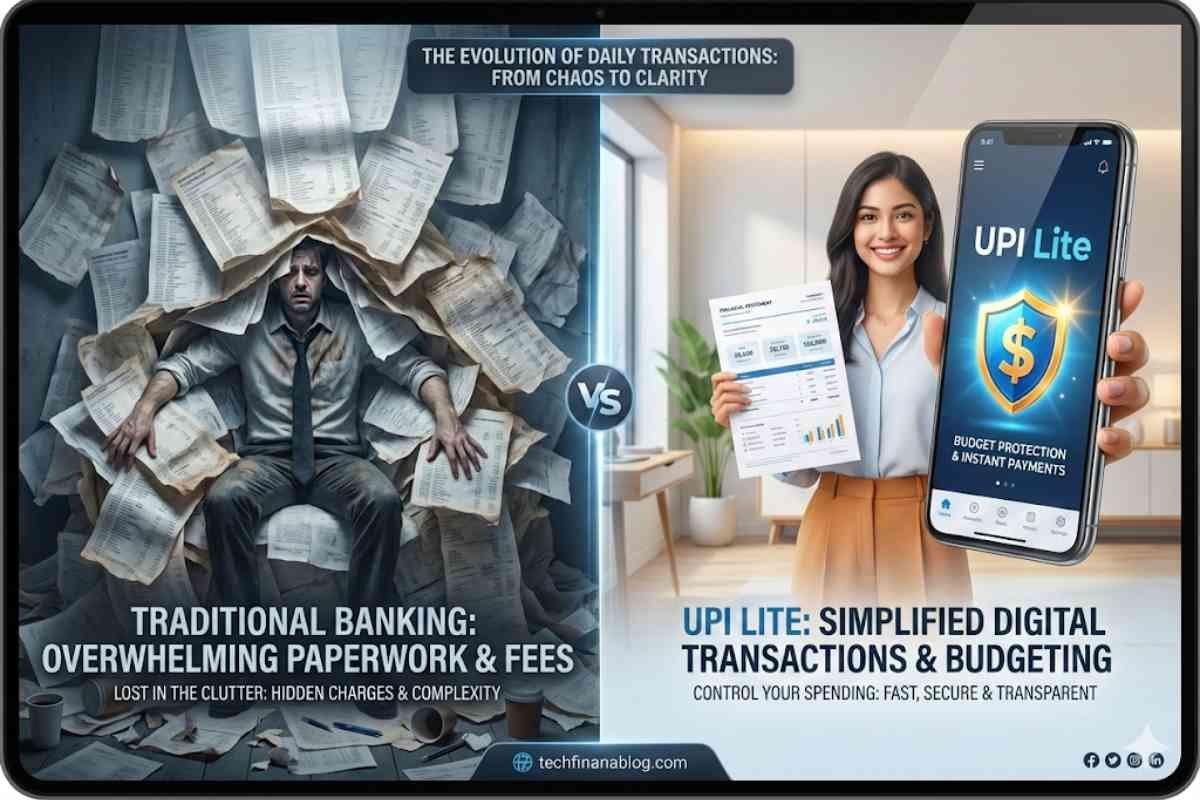
Open your banking app right now and look at your transaction history. What do you see? If you are like the average Indian in 2025, you don’t see a clear list of your wealth. You see a chaotic, endless scroll of clutter: ₹15 for chai, ₹28 for milk, ₹40 for an auto ride, ₹10 for a chocolate. Your bank statement, once a dignified record of your financial life, has turned into a glorified grocery receipt. This “digital noise” is not just annoying; it is expensive. It hides your real spending habits, masks subscription leaks, and creates a psychological fog that prevents you from building wealth.
Enter UPI Lite. Launched quietly by the NPCI, it was marketed as a tech upgrade to make small payments faster and to reduce the load on bank servers. It allows you to load a small amount (up to ₹2,000) into an on-device wallet and make payments up to ₹500 without entering a PIN. Convenient? Yes. But if you look closer, it is much more than that. It is arguably the most powerful budgeting tool ever given to the Indian consumer. By using UPI Lite strategically, you can segregate your “petty cash” from your “wealth,” unclutter your financial mind, and plug the leaks that are draining your wallet. Here is the complete strategy guide on how to use this feature to save up to ₹50,000 a year.

The Problem: The “Death by a Thousand Cuts”
Why do we overspend? Behavioral economists call it the “Latte Factor,” but in India, it’s the “Chai-Sutta Factor.” Because UPI is frictionless and connected directly to our main bank account, we treat our life savings like a coin purse. When you tap to pay ₹20, you aren’t mentally deducting it from a budget; you are just dipping into an infinite pool.
These small, mindless transactions add up. A ₹20 snack here, a ₹50 impulse buy there, a ₹100 auto ride because you were lazy to walk. Before you know it, you are bleeding ₹150 to ₹200 a day in unnecessary expenses. That’s ₹5,000 to ₹6,000 a month. That’s ₹60,000 to ₹72,000 a year.
The clutter on your bank statement also makes it impossible to spot the real demons: the double-charged Netflix subscription, the annual fee you didn’t agree to, or the creeping increase in your utility bills. They are buried under a mountain of ₹10 transactions.
The UPI Lite Solution: The Digital ‘Gullak’ Strategy
UPI Lite recreates the psychology of physical cash without the hassle of physical cash. It acts as a digital gullak (piggy bank) or a dedicated “expense wallet.” Here is the step-by-step strategy to turn this feature into a savings machine.
Step 1: The Setup (The Partition)
Activate UPI Lite on your preferred app (GPay, PhonePe, Paytm). It takes seconds. Now, treat this wallet as your “Daily Allowance.” This is the most critical mental shift. Your main bank account is for Wealth (Savings, Investments, EMI, Rent). Your UPI Lite wallet is for Expenses (Chai, Commute, Vegetables, Snacks).
Step 2: The ‘Hard Cap’ Rule
Calculate a reasonable weekly budget for your miscellaneous, small-ticket expenses. Let’s say it’s ₹2,000 a week.
- The Action: Load exactly ₹2,000 into your UPI Lite wallet on Monday morning.
- The Rule: This is your limit for the week. You use UPI Lite for every transaction under ₹500.
- The Discipline: If the wallet runs dry by Thursday, you are done. You cannot dip into your main bank account for a samosa. You have to wait until next Monday or suffer the “shame” of breaking your rule.
This re-introduces the “pain of paying.” When you see your Lite balance drop from ₹2,000 to ₹500, you naturally start rationing your spending. You skip that extra coffee. You walk instead of taking an auto. You stop buying things you don’t need.
Step 3: The Statement Detox
One of the best technical features of UPI Lite is that individual transactions do not appear on your main bank statement. Only the top-up amount (e.g., “Debit ₹2,000 to UPI Lite”) appears.
- The Benefit: Your bank statement shrinks from 10 pages to 1 page.
- The Audit: Now, sit down with your statement. Because it is clean, you can instantly spot the anomalies. “Wait, why is there a ₹999 debit for a subscription I cancelled?” “Why is my electricity bill ₹400 higher this month?”
- The Saving: Catching just one or two wrongful charges or forgotten subscriptions a year can save you ₹5,000 to ₹10,000.
Step 4: The Speed Advantage (Time is Money)
UPI Lite does not hit the bank’s core banking servers. It works even when your bank is facing a server outage (a common occurrence with major banks).
- The Scenario: You are at a busy counter. You try to pay ₹300. The bank server is down. Flustered, you pay with a credit card (incurring debt) or break a ₹2,000 note (which inevitably gets spent on loose change expenses).
- The Fix: UPI Lite has a near-100% success rate. It prevents you from reverting to less efficient or debt-prone payment methods in moments of panic.
The Math: How to Hit ₹50,000
Let’s break down the potential annual savings using the UPI Lite Strategy:
- The Impulse Brake: By using the “Hard Cap” rule, you reduce your daily miscellaneous spending by just ₹100 a day. (That’s one less fancy coffee, or two less snacks, or one avoided auto ride).
- Calculation: ₹100 x 365 days = ₹36,500 Saved.
- The Statement Audit: By decluttering your statement, you identify and cancel one unused monthly subscription (₹299) and catch one billing error (₹1,000).
- Calculation: (₹299 x 12) + ₹1,000 = ₹4,588 Saved.
- The ‘Latte’ Inflation: By budgeting a fixed amount, you avoid “lifestyle creep.” If you don’t cap it, your daily spend naturally rises by 10% a year. On a ₹200/day habit, preventing that rise saves you money.
- Calculation: Preventing ₹20/day creep = ₹7,300 Saved.
Total Potential Savings: ₹36,500 + ₹4,588 + ₹7,300 = ₹48,388 (approx ₹50,000)
Conclusion: Wealth is a Habit, Not a Number
UPI Lite is a perfect example of how technology can be used either to distract us or to discipline us. If you use it mindlessly, it’s just another way to spend money. But if you use it as a tool—as a digital partition between your savings and your spending—it becomes a powerful wealth-building ally.
It brings back the discipline of the cash envelope system with the convenience of the digital age. It cleans up your mess, both in your passbook and in your habits. So, go ahead. Activate UPI Lite. Load your weekly limit. And watch how a simple change in how you pay changes what you save.
Call to Action:
Are you tired of seeing “Payment to Chai Wala” fifty times on your bank statement? Try the UPI Lite strategy for one week and tell us how it felt! Did you spend less? Share your experience in the comments below. Forward this guide to your friend whose bank statement looks like a novel, and follow IndiLogs for more smart money hacks.