Table of Contents
In the not-so-distant past, commerce in India ran on a currency far more volatile than the Rupee: it ran on zubaan (word of honour). The local kirana store owner didn’t need a credit check to give you a month’s worth of groceries; he knew your father. A friend returning a loan didn’t need a receipt; a handshake and a “Thanks, yaar” were enough. Trust was biological, interpersonal, and deeply human. It was also messy, prone to amnesia, and occasionally catastrophic.
Then came the Unified Payments Interface (UPI). It didn’t just digitize our money; it digitized our trust. Over the last few years, a silent psychological shift has occurred. We have stopped trusting the person standing in front of us and started trusting the server humming in a data center hundreds of kilometers away.
We value the notification over the nod. We believe the green tick more than the sworn promise. This shift wasn’t accidental; it was engineered by five specific features of the UPI ecosystem that systematically dismantled human fallibility and replaced it with algorithmic certainty. Here is how technology became the new Munshi (accountant) of our moral universe.
1. The ‘Name Fetch’ API: The End of Stranger Danger
Do you remember the anxiety of the NEFT era? You had to type in an account number and an IFSC code, praying to the banking gods that you didn’t mistype a zero as an ‘O’. Sending money to a stranger or a new vendor required a leap of faith.
UPI introduced the ‘Name Fetch’ feature—a seemingly small innovation with massive psychological weight. You type in a phone number, and before you even enter the amount, the system pulls the verified banking name of the recipient from the database. “RAMESH KUMAR” flashes on your screen.
In that split second, the technology validates the human. You don’t need to ask the person, “Is this your number?” You don’t need to trust their memory. The system has vetted them for you. This feature eliminated the fear of the “wrong number” and created a unique dynamic where we trust the database’s identification of a person more than the person’s own introduction. We have all seen people at counters showing their screen to the vendor saying, “See? It says your name here,” as if the phone knows the vendor better than he knows himself.
2. The ‘Payment Successful’ Green Tick: The Ultimate Truth Serum
There was a brief, chaotic window in the early days of digital wallets where the “Fake Screenshot” scam thrived. Fraudsters would show a doctored image of a payment confirmation to a busy shopkeeper and walk away with free goods. It was a failure of digital trust.
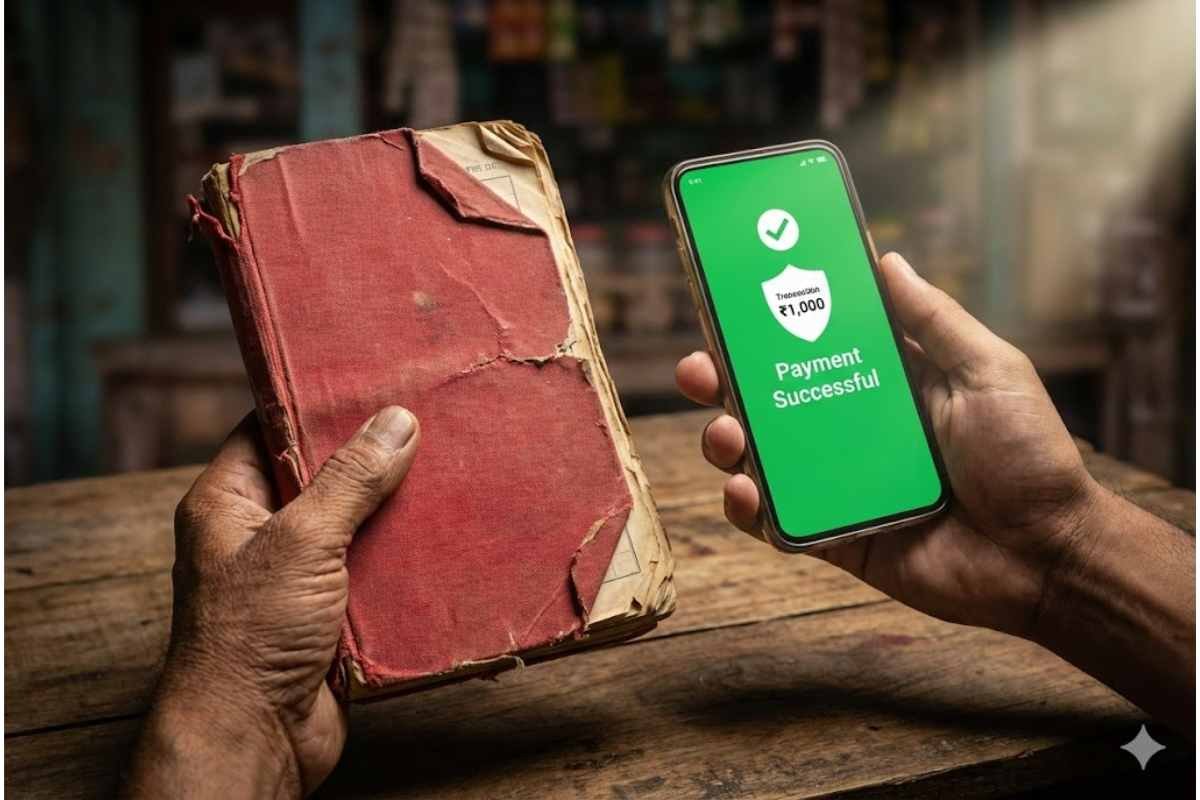
Then, UPI apps evolved the dynamic “Payment Successful” screen—often accompanied by a specific sound, a vibration, or an animation (like Google Pay’s scratching card or PhonePe’s bouncing shield). This Green Tick became the ultimate truth serum.
Today, a customer can swear on their mother’s life that they have sent the money. They can plead, argue, and cajole. But the shopkeeper will not budge until he sees that specific animation or the Green Tick on his own device. The human promise (“Bhaiya, network slow hai, aa jayega” – Brother, network is slow, it will come) has zero value against the algorithmic confirmation. The Green Tick is the gavel of the modern judge; until it falls, no truth has been spoken.
3. The Soundbox: The Voice of God in a Plastic Box
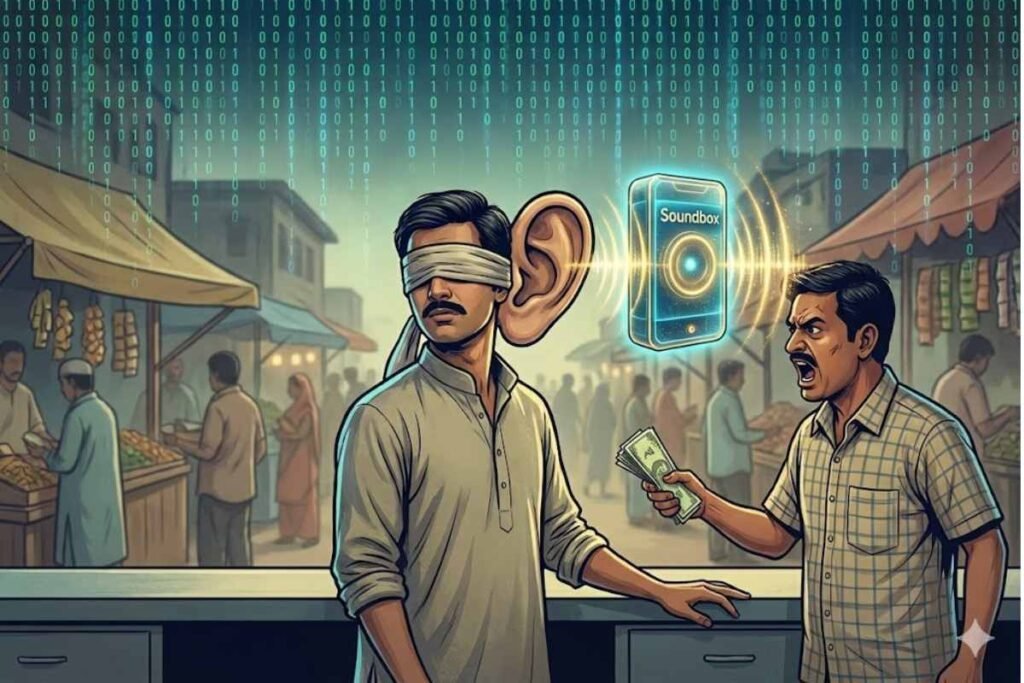
If there is one device that symbolizes the complete transfer of trust from man to machine, it is the Soundbox. Walk into any busy Indian market, and you will hear the chorus of robotic voices announcing, “Paytm par pachaas rupaye prapt huye” (Received 50 rupees on Paytm).
This innovation was born from a “trust gap.” Shopkeepers were too busy to check their phones for every SMS. Customers were in a rush. There was friction. The Soundbox removed the human element entirely. The shopkeeper no longer looks at the customer for confirmation. He doesn’t even look at his own phone. He keeps working, chopping vegetables or packing items, waiting for the machine to tell him the transaction is valid.
The Soundbox is the impartial referee. It cannot be bribed, it cannot lie, and it doesn’t make mistakes. In millions of transactions daily, the human voice of the customer saying “I paid” is ignored in favour of the synthetic voice of the box. It is a stunning sociological phenomenon: we trust a speaker more than a person.
4. The Immutable Transaction History: The Death of ‘Golmaal’
The Indian system of hisaab-kitaab (accounting) was traditionally kept in red bahi khata notebooks or messy scraps of paper. It was a system ripe for golmaal (shady business). “I paid you last week!” “No, you didn’t!” These arguments were the soundtrack of commercial relationships. Memory is fallible; ink can be smudged.
UPI’s Transaction History is the new, immutable scripture. It serves as a perfect, unalterable digital memory. Now, when there is a dispute, no one argues based on memory. No one says, “I promise I paid.” They simply open their phones and scroll.
“Show me the UTR number.”
This sentence has replaced hours of arguing. The Transaction ID (UTR) is a piece of data that creates absolute trust. If the UTR exists, the event happened. If it doesn’t, it didn’t. Reality has been reduced to a database entry. We have outsourced our memory to the cloud, and in doing so, we have accepted that the digital record is the only record that matters.
5. The ‘Request Money’ Feature: The End of Polite Ambiguity
Borrowing money or splitting bills used to be a dance of polite ambiguity. “You pay now, we’ll settle later.” And “later” often never came because asking for your money back felt petty or awkward. We trusted our friends to remember, and often, they “forgot.”
The ‘Request Money’ feature on UPI apps mechanized this social contract. Now, you don’t need to have the awkward conversation. You simply send a request: “You owe ₹450.” It appears as a notification on their screen. It’s a digital demand letter.
This innovation shifted trust from a “promise to pay” to a “notification to pay.” It removes the reliance on the borrower’s conscience. You don’t trust them to remember; you trust the app to remind them. It turns a social obligation into a digital task, stripping the emotion out of the exchange and ensuring that debts are settled with mathematical precision rather than vague promises.
Conclusion: The Algorithm is the New ‘Bharosa’
There is a profound irony in this shift. Indians, culturally, are “high-context” people. We value relationships, face-to-face interactions, and social bonds. Yet, we have adopted these “trust-less” technologies faster than almost anyone else in the world.
Why? Because for all our talk of bharosa, we know that human systems are flawed. Humans forget, humans lie, and humans make mistakes. UPI offered us something seductive: a world without ambiguity. A world where the money is either there or it isn’t.
We haven’t stopped trusting; we’ve just reallocated our trust. We have taken it away from the fallible, messy, emotional human beings around us and deposited it into the clean, binary, incorruptible logic of the code. In the new India, God is in the details, but the Truth is in the transaction history.
Call to Action:
Have you ever had an argument that was instantly settled by a UPI screenshot? Or do you find yourself waiting for the Soundbox voice before you believe a customer? We want to hear your stories of “Digital Trust.” Share them in the comments below. Forward this article to the friend who always asks for the UTR number, and follow IndiLogs as we decode the changing soul of India.