Table of Contents
Before you walk into that glass-walled boardroom to negotiate a multi-crore contract, before you prep your slides and rehearse your pitch, you must first face the ultimate gatekeeper of Indian commerce: the auto-rickshaw driver. That five-minute, seemingly chaotic haggle over a three-kilometre fare is not just a daily chore; it is the most intense, practical, and brutally effective negotiation workshop you will ever attend.
We spend lakhs on sales training and devour books on negotiation theory, yet the most profound lessons are being taught every day on our street corners. The auto-wallah is a grandmaster of human psychology, a black belt in pricing strategy, and a virtuoso of reading a customer. He operates in a hyper-competitive market with perishable inventory (an empty seat is lost revenue) and closes dozens of deals a day. The tactics he employs, honed by thousands of hours of real-world practice, are not just applicable to the corporate world—they are a direct, unfiltered masterclass. Here are eight lessons from his playbook that can help you close your next million-dollar deal.
1. Qualify Your Lead in Three Seconds Flat
Before a single word is spoken, the driver has already built a detailed profile of you. Are you clutching a suitcase? Airport fare, high urgency, less price sensitive. Fiddling with Google Maps? New to the area, poor knowledge of local rates. Dressed in a sharp suit? Corporate traveller, expense account. This lightning-fast qualification process determines his entire opening strategy.
The Corporate Parallel: How well do you qualify your leads before the first call? Don’t just look at their company’s revenue. Research their specific department’s budget, the decision-maker’s pain points on LinkedIn, and any recent news that might indicate urgency. Stop wasting time on unqualified leads; learn to profile your customer with the ruthless efficiency of a driver sizing you up from 50 feet away.

2. The Art of the Outrageous Anchor Price
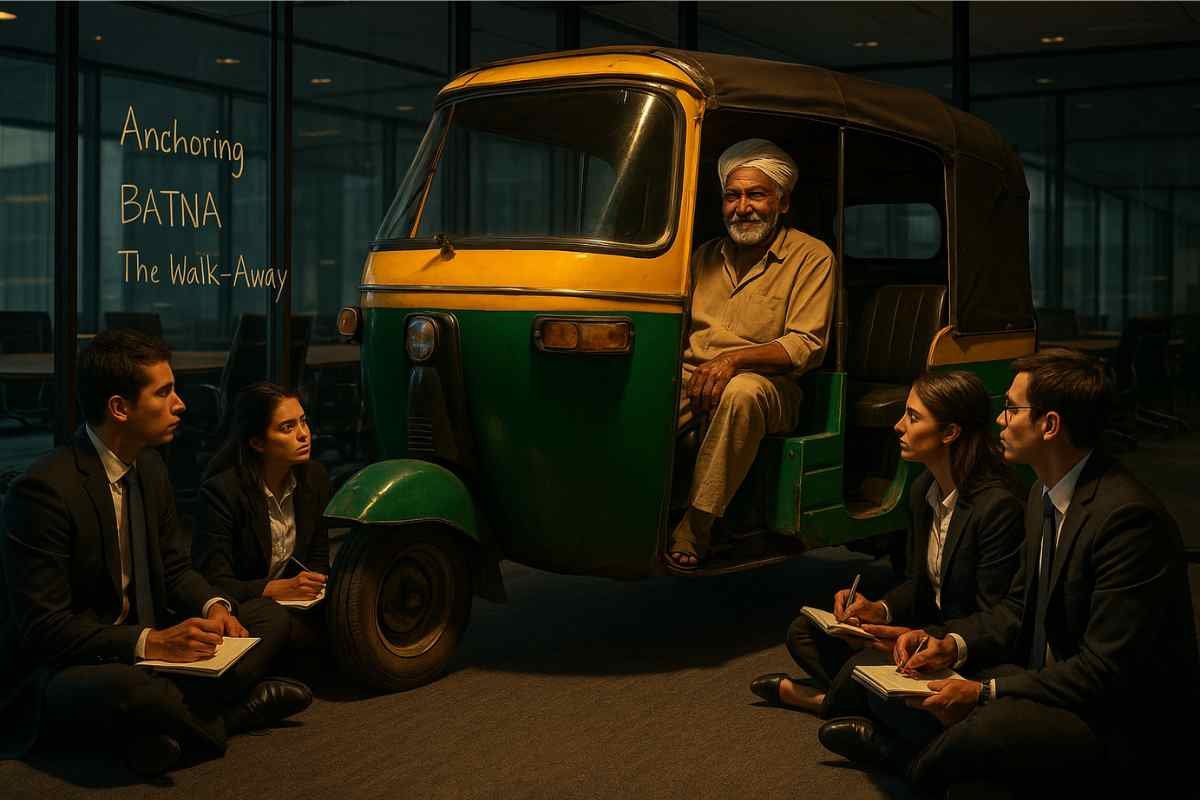
His opening quote for a non-metered ride is never reasonable. It’s intentionally, almost comically, high. This isn’t a mistake; it’s a textbook negotiation tactic called “anchoring.” By starting at ₹300 for a ride that should cost ₹100, he has mentally anchored your perception of the price. Your counteroffer of ₹150 now seems incredibly reasonable to him, even though it’s still 50% higher than the fair price. He has shifted the entire negotiation in his favour before you’ve even settled in.
The Corporate Parallel: In a B2B deal, are you starting the pricing discussion with your best, discounted offer? Stop. Anchor the negotiation with the full value of your premium, all-inclusive package. Even if the client negotiates down from there, they will be negotiating from your high anchor, not from their low expectation.
3. Master the Power of Saying ‘No’ (and Knowing When They Will)
The driver’s most powerful word is “Nahin, Posaata nahi” (No, it’s not feasible). He will say it with complete conviction, even if he has no other passenger in sight. He understands his BATNA (Best Alternative to a Negotiated Agreement)—he can wait for another passenger. Crucially, he is also an expert at sensing your BATNA. He knows that if there are five other empty autos lined up behind him, his leverage is low. If he’s the only ride in a sudden downpour, his leverage is absolute.
The Corporate Parallel: Enter every negotiation knowing your walk-away point. More importantly, have a deep understanding of your client’s alternatives. Are you their only viable solution, or are they talking to three of your competitors? Your power comes not from your product, but from the client’s lack of good alternatives.
4. Create Scarcity and Urgency Out of Thin Air
“Jaldi bolo, madam, peeche सवारी खड़ी है” (Tell me quickly, madam, another passenger is waiting). Is there really another passenger? Probably not. But he has masterfully created a sense of urgency and scarcity. He’s not just a commodity; he’s a resource in demand. This psychological pressure rushes your decision-making, making you more likely to accept a less-than-perfect offer.
The Corporate Parallel: Limited-time offers, early-bird discounts, or mentioning that your implementation team is getting booked up for the next quarter are all ways to create ethical scarcity. It encourages a client who is “just looking” to make a decision, transforming a “maybe later” into a “yes now.”
5. The Strategic Walk-Away
This is the ultimate power move. You state your final price, he refuses, and you turn and start walking away. The silence is deafening. Then, just as you’re about ten paces away, you hear the magic words: “Achha, chalo, baitho!” (Okay, come on, sit!). The walk-away demonstrates that your ‘final offer’ was truly final. It’s a high-risk, high-reward move that only works if you are genuinely willing to walk.
The Corporate Parallel: Sometimes the best way to close a stalled deal is to politely signal that you are moving on. A simple, professional email stating, “Since we haven’t been able to reach an agreement, we’ll be focusing our resources elsewhere for now, but please keep us in mind for the future,” can often trigger a surprisingly quick positive response from a client who thought they had all the time in the world.
6. Upsell at the Point of Maximum Leverage
The deal is done. You’ve agreed on a price. You’re halfway to your destination, stuck in traffic. This is the point of maximum leverage. This is when you hear, “Sir, AC ka extra lagega” (Sir, there will be an extra charge for the AC) or “Luggage ka 20 rupiya alag se” (₹20 extra for the luggage). You’re already a captive audience; you have no choice but to agree. It’s a brilliant, if infuriating, upsell.
The Corporate Parallel: Once a client has signed the main contract and is deeply invested in your solution, their resistance to add-ons is at its lowest. This is the perfect time to introduce value-added services like premium support, extra training modules, or advanced analytics features.
7. Build Micro-Rapport (Then Monetize It)
Some of the most skilled drivers will start with a friendly comment about the weather, the traffic, or the cricket score. This isn’t just small talk. It’s a deliberate tactic to disarm you, to transform the interaction from a cold transaction into a brief human connection. By the time you start talking price, he’s not an anonymous driver; he’s the friendly bhaiya who also hates the humidity. You are psychologically primed to be less aggressive in your negotiation.
The Corporate Parallel: The five minutes of rapport-building at the start of a sales call is not wasted time. It’s a critical investment. Finding a shared connection—a common university, a mutual interest—can be the lubricant that makes the entire negotiation process smoother.
8. Know When to Ditch the Haggle and Go by the Book
The ultimate paradox: the wisest drivers, especially in cities with strict enforcement, know when not to negotiate at all. They point to the meter and say, “Meter se chalo, sir.” They understand that in certain situations, playing by the rules builds trust, guarantees a fair return, and is simply more efficient.
The Corporate Parallel: Sometimes, the best negotiation is no negotiation. Having a clear, transparent, and non-negotiable pricing structure for certain products or client tiers can build immense trust and brand integrity. It tells the market that you value your product fairly and you treat all your customers equally.
The next time you flag down an auto, don’t see it as a chore. See it as a field study. Observe the master at work. Because the same human psychology that decides a hundred-rupee fare on a dusty Indian road is at play in every million-dollar deal in a high-rise office tower.
What’s the best negotiation tactic you’ve ever witnessed from an auto-rickshaw driver? Share your story in the comments below! If this piece gave you a new perspective, share it with a salesperson or founder who needs it.