Table of Contents
Picture this: Three hundred hangry guests, a power outage during the sangeet, the star photographer stuck in traffic, and the groom’s ceremonial horse has just decided to bolt. For most project managers, this combination of calamities would be a career-ending nightmare. For a seasoned Indian wedding planner, it’s just Tuesday.
The great Indian wedding is not just a celebration; it’s a multi-day, high-stakes, emotionally charged logistical labyrinth involving hundreds of stakeholders, unpredictable variables, and zero room for failure. You can’t just “postpone the launch” when the bride is ready.
The men and women who orchestrate these magnificent, chaotic events are not just planners; they are the unsung grandmasters of crisis management. Their ability to anticipate problems, solve issues in real-time, and ensure the show goes on, no matter what, offers a powerful, real-world framework for any professional managing a complex project.
Forget your sterile project management textbooks; the real lessons in risk mitigation are learned amidst the marigolds and mayhem. Here are six powerful crisis management secrets from the Indian wedding planner’s playbook.
1. “The Black Book of Backups” (Redundancy is Your Religion)
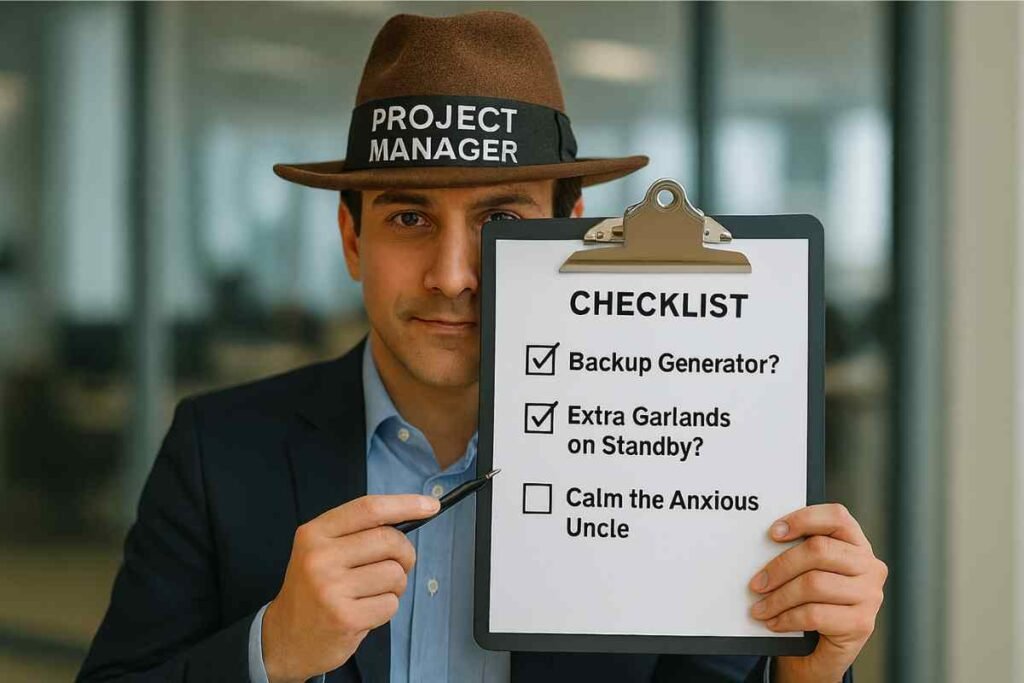
The Wedding Planner’s Method: A good wedding planner doesn’t have a Plan B; they have a Plan B, C, D, and E. The main caterer has a backup on standby. The generator has a backup generator. The DJ has a backup playlist on a separate device. For every critical vendor, from the florist to the priest (panditji), there is a name and number in a “black book” who can be activated at a moment’s notice. They plan for failure at every critical point.
The Project Management Lesson: Identify every single point of failure in your project and build in redundancy. Is your entire project dependent on one key developer? What’s the plan if they get sick? Is your data stored on a single server? Where is the backup? Is your launch reliant on a single marketing channel? What are your alternative channels? Don’t just hope for the best; actively plan for the worst. True risk management isn’t about preventing all failures; it’s about ensuring no single failure can derail the entire project.
2. The “Pre-Mortem” Pooja (Anticipating Problems Before They Happen)
The Wedding Planner’s Method: Weeks before the wedding, the planner visualizes the entire event, from the baraat’s procession to the vidaai. They walk through every step, but with a pessimistic lens: “What if it rains during the outdoor mehendi? What if the elderly relatives can’t climb the stairs? What if the groom’s sherwani button pops off?” They identify dozens of potential problems and create solutions before they ever happen (e.g., waterproof tents on standby, a designated volunteer for elders, a mini sewing kit in their emergency bag).
The Project Management Lesson: Conduct a “pre-mortem” for every major project. Gather your team and ask one question: “Imagine this project has failed spectacularly. What went wrong?” This exercise, where you work backward from a hypothetical failure, is incredibly effective at uncovering potential risks that you might miss in a state of optimistic planning. It allows you to build preventative measures directly into your project plan.
3. “The Art of the On-the-Spot Jugaad” (Creative Real-Time Problem Solving)
The Wedding Planner’s Method: The ice sculpture for the reception has started melting prematurely. The planner doesn’t panic. They instruct the staff to surround it with ferns and spotlights, reframing it as a “misty mountain” art installation. They are masters of the ingenious, on-the-spot workaround (jugaad). Their job is to find a solution, any solution, that keeps the event’s positive atmosphere intact.
The Project Management Lesson: Cultivate a culture of creative problem-solving, not blame. When a crisis hits, the first question shouldn’t be “Whose fault is it?” but “How do we fix this right now with the resources we have?” Empower your team to think on their feet and improvise. Sometimes, the most elegant solution isn’t the one you planned, but the one you invent under pressure.
4. “The Stakeholder Whisperer” (Managing a Universe of Egos)
The Wedding Planner’s Method: A wedding involves managing the (often conflicting) expectations of the bride, the groom, both sets of parents, key relatives, and dozens of vendors. The planner is a master diplomat, constantly communicating, reassuring, and managing egos. They know who the real decision-makers are and keep them informed, preventing small anxieties from escalating into major dramas.
The Project Management Lesson: Proactive and tailored stakeholder communication is 90% of crisis prevention. Identify all your key stakeholders – your client, your boss, your team, other departments. Understand their priorities and anxieties. Keep them informed with regular, clear updates, especially when things are going wrong. A stakeholder who is kept in the loop is a partner in the solution; a stakeholder who is left in the dark is a potential source of panic and conflict.
5. “The Emergency Kit” (Being Prepared for the Small Stuff)
The Wedding Planner’s Method: Every seasoned planner carries a “Mary Poppins” bag of tricks – a kit containing everything from safety pins and stain remover to headache tablets and energy bars. They know that sometimes, a major crisis can be averted by solving a small, personal problem for a key stakeholder (like a headache for the mother of the bride).
The Project Management Lesson: Anticipate and prepare for the small, operational frictions. This could be a “project emergency kit” with extra laptop chargers, key contact lists printed out, or pre-paid data dongles in case the office Wi-Fi fails during a critical presentation. Being prepared for the small, predictable problems frees up your mental bandwidth to deal with the large, unpredictable ones.
6. “Maintaining Calm Amidst the Storm” (The Power of Emotional Regulation)
The Wedding Planner’s Method: The planner is the calm, un-flappable eye of the hurricane. Even if everything is going wrong behind the scenes, their forward-facing demeanor is one of serene control. Their calmness is contagious; it reassures the client and empowers their team to execute solutions without panic.
The Project Management Lesson: As a leader, your emotional state during a crisis sets the tone for everyone else. If you panic, your team will panic. If you remain calm, focused, and solution-oriented, they will too. Practice emotional regulation. Acknowledge the problem, but project confidence in your team’s ability to solve it. Your calm is your ultimate crisis management tool.
Managing a complex project is like planning a great Indian wedding. There will be unpredictable variables, emotional stakeholders, and moments where you feel like a groomsman’s horse has just bolted with your budget. By adopting the Indian wedding planner’s mindset – preparing for every eventuality, solving problems creatively, communicating relentlessly, and maintaining a core of unshakeable calm – you can navigate the inevitable crises and lead your team to a successful, celebratory finish.