Table of Contents
In the glittering world of Indian startups, the headline has become the holy grail. “XYZ Startup raises $50 Million in Series B.” It’s celebrated with breathless LinkedIn posts, congratulatory tweets, and front-page features. The founder is hailed as a hero, having successfully navigated another round of the great fundraising game. But scratch beneath the surface of this celebration, and you often find a disturbing reality: a company that is bleeding cash, has no clear path to profitability, and is now shackled to a growth-at-all-costs treadmill that is accelerating dangerously.
We have imported a Silicon Valley narrative that equates fundraising with success, and valuation with value. This is a dangerous conflation. For many Indian founders, the VC dream is not a path to liberation; it’s a trap. It forces businesses that could have been healthy, profitable, and sustainable to mutate into bloated, cash-burning monsters that must either keep feeding on ever-larger rounds of capital or die. It’s time to ask a hard question: Is your obsession with funding killing the very soul of your business?
The Cult of ‘Growth at All Costs’: A Dangerous Import
The Venture Capital model is built on a very specific kind of mathematics. VCs need massive, outlier returns—the 100x exits—to make their fund economics work. This means they need every company in their portfolio to swing for the fences, attempting to become a unicorn in five to seven years.
This pressure forces founders to prioritize reckless top-line growth over fundamental unit economics. You start subsidizing customers to show user growth. You hire aggressively before you have product-market fit. You spend millions on brand marketing when your retention rates are abysmal. The goal is no longer to build a great business; it’s to hit the metrics needed for the next round of funding. The company becomes a fundraising machine, not a value-creation machine. In the Indian context, where market depth is often shallower than in the US and price sensitivity is far higher, this “blitzscaling” model frequently leads to disaster once the funding tap runs dry.
The Golden Handcuffs: Losing Control of Your Destiny
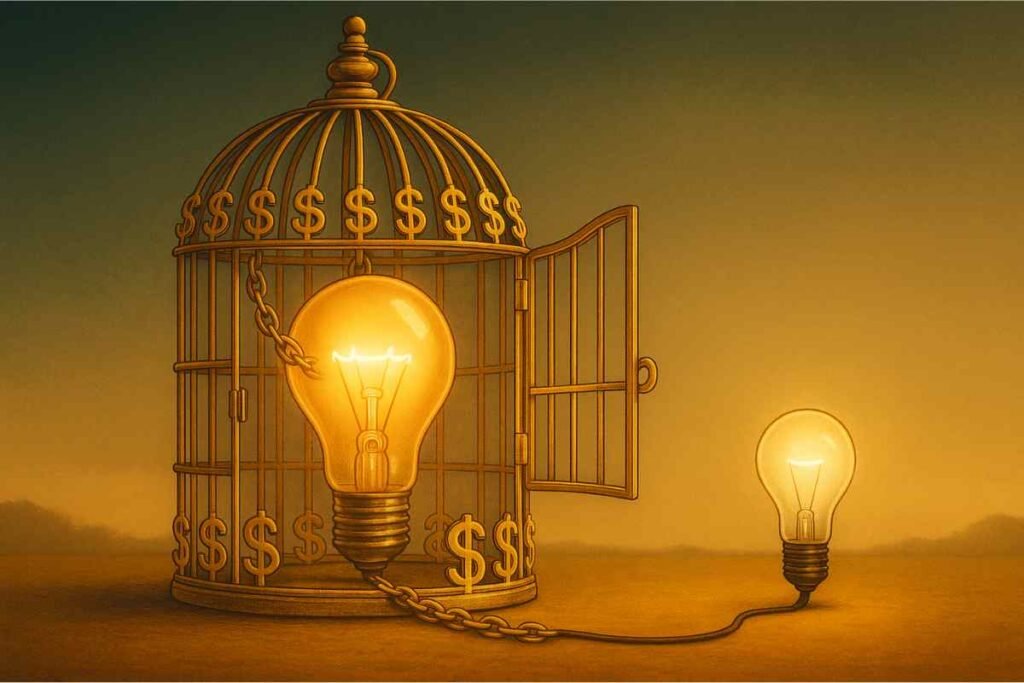
When you take VC money, you are not just taking capital; you are taking on a new boss. And this boss has a very different agenda than you might. While you may want to build a lasting institution that serves its customers and employees for decades, the VC is on a clock. They need an exit—an IPO or an acquisition—within a specific timeframe to return money to their own investors (Limited Partners).
This misalignment can be fatal. Founders are often pushed into decisions they know are wrong for the long-term health of the business—entering markets they aren’t ready for, launching products prematurely, or pivoting away from a niche, profitable core to chase a larger, intensely competitive market. The freedom you sought by becoming an entrepreneur is traded for a gilded cage, where you are a highly paid employee executing someone else’s aggressive growth strategy.
The Quiet Revolution: The Rise of the Bootstrapped Champions
While the unicorns grab the headlines, a quiet revolution is happening in India. A growing tribe of founders is rejecting the VC treadmill and choosing to build the old-fashioned way: with customer revenue.
Look at Zoho, the SaaS giant from Chennai. Sridhar Vembu built a multi-billion dollar global enterprise without taking a single rupee of external funding. Zoho didn’t have to burn cash to acquire customers; it had to build a product so good that customers were willing to pay for it from day one. This discipline created a fundamentally antifragile business.
Or consider Zerodha, India’s largest stockbroker. Nithin and Nikhil Kamath bootstrapped it into a profit machine that puts most funded unicorns to shame. Because they didn’t have investor pressure, they could make contrarian decisions—like not spending on advertising for years—that turned out to be brilliant long-term strategies. These companies didn’t just survive without VC money; they thrived because they didn’t have it. They were forced to be disciplined, customer-obsessed, and profitable from the start.
Profit is Freedom
In the Indian context, the “Dhanda” mindset—where profit is the only real metric of business health—is far more culturally aligned than the Silicon Valley “burn rate” mindset. A profitable business is a free business. It doesn’t need to beg for its existence every 18 months. It can weather economic downturns without massive layoffs. It can afford to think in decades, not just quarters.
It’s time to rewrite the definition of startup success in India. Success is not raising a Series A. Success is building a product that customers love enough to pay for, creating a workplace that employees are proud of, and generating profits that allow you to control your own destiny. If VC money helps you accelerate that, great. But if it requires you to sacrifice it, then it’s not a dream; it’s a very expensive delusion.
Are you a bootstrapped founder fighting the good fight? Or have you seen the dark side of VC funding? Share your experiences in the comments below. Let’s start a real conversation about what building a healthy business truly means.