Table of Contents
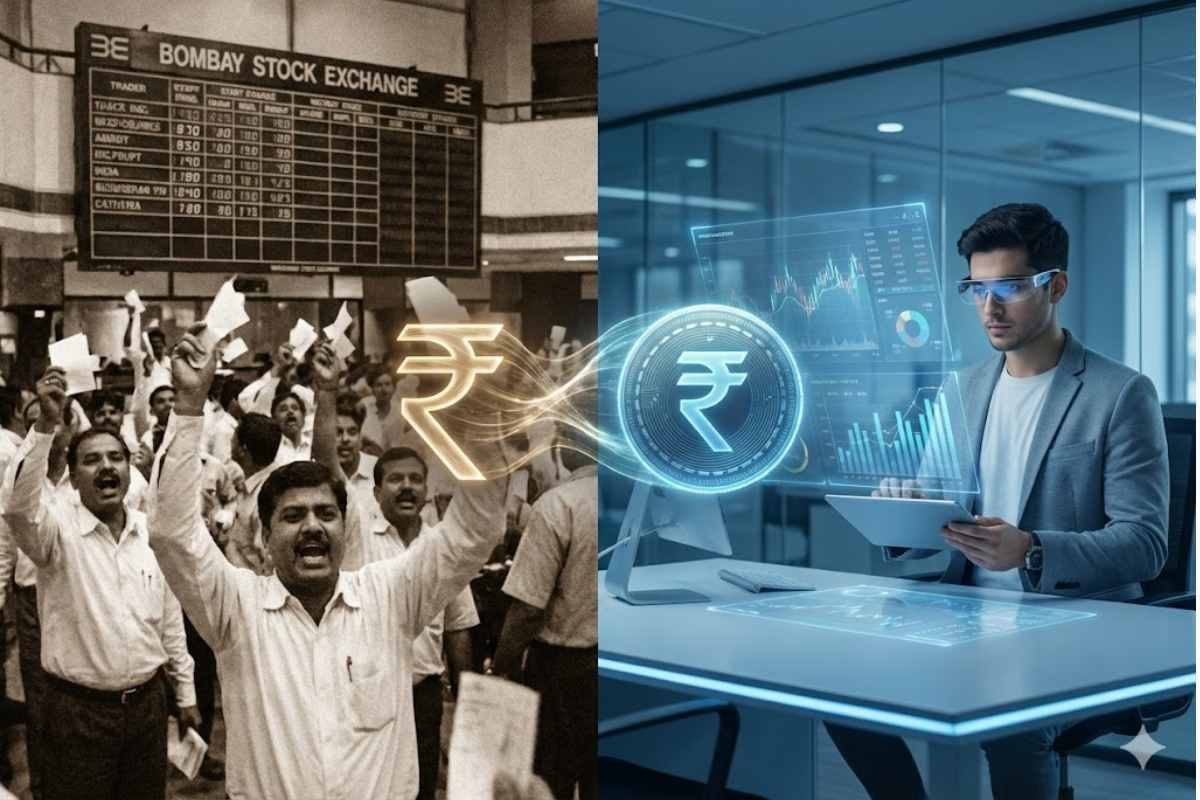
In the glossy boardrooms of Dalal Street and the frantic trading floors of Mumbai, analysts are constantly obsessed with “forecasting.” They build complex models, track high-frequency indicators, and listen to every syllable uttered by the Reserve Bank of India Governor. But often, the most accurate predictor of India’s economic future isn’t a complex algorithm; it’s a history book.
Mark Twain famously said, “History doesn’t repeat itself, but it often rhymes.” Nowhere is this truer than in the Indian economy. Since the liberalization of 1991, India has moved in distinct, identifiable cycles. The forces that drove the IT boom in the 2000s are rhyming with the forces driving the SaaS boom today. The infrastructure push of the Vajpayee era is rhyming with the current government’s CAPEX explosion.
India is currently projected to clock a GDP growth of 6.2% to 6.3% in the coming fiscal years, maintaining its status as the fastest-growing major economy. To capitalize on this “Amrit Kaal,” smart entrepreneurs and investors don’t just look at the ticker tape; they look at the timeline. By understanding the DNA of our past growth, we can map out the opportunity zones of the future. Here are 8 historical patterns that act as a compass for navigating India’s economic future.
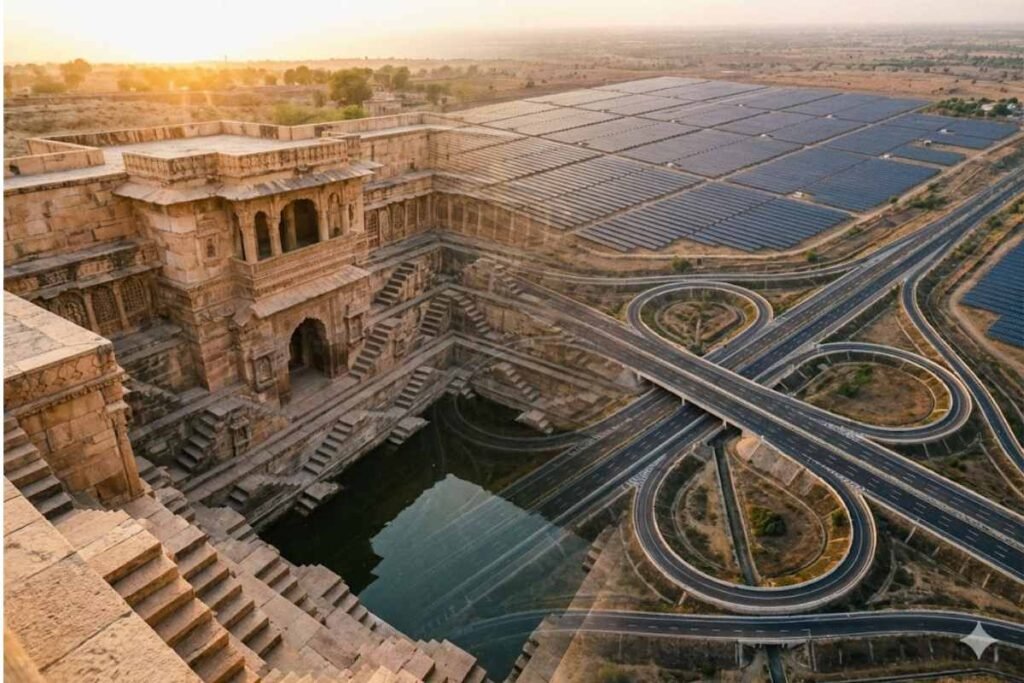
1. The ‘Leapfrog’ Phenomenon: Skipping the Middle Step
The History: India rarely follows the linear path of development. We didn’t go from landlines to pagers to mobile phones; we leapfrogged straight from no phones to smartphones. We didn’t go from cash to credit cards to digital; we jumped straight to UPI.
The Prediction: Look for sectors where India is currently behind. We won’t catch up linearly; we will skip a step.
- The Opportunity: Energy. India will likely skip the “gas-guzzling hybrid” phase of the West and leapfrog directly to Green Hydrogen and affordable EVs. Invest in companies building the charging infrastructure or green energy grids.
- Career Move: Don’t train for legacy industries (like traditional internal combustion engine maintenance); train for the leapfrog technology (battery chemistry, renewable grid management).
2. The ‘Crisis-Reform’ Trigger
The History: India’s biggest reforms have always been born out of crisis. The 1991 Balance of Payments crisis gave us Liberalization. The 2013 “Fragile Five” currency scare led to inflation targeting. The COVID-19 pandemic forced the rapid digitization of the economy and healthcare.
The Prediction: Do not fear crises; watch them closely. The pain point of today is the policy reform of tomorrow.
- The Opportunity: The current global supply chain crisis (“China Plus One”) is triggering the PLI (Production Linked Incentive) schemes. This is not a temporary blip; it’s a structural shift.
- Investment: Betting on manufacturing sectors currently under stress but receiving government attention (like semiconductors or defense) is a historically sound strategy.
3. The ‘Sachetisation’ of Everything (Democratization)
The History: In the 90s, FMCG giants realized they couldn’t sell ₹100 shampoo bottles to rural India, so they invented the ₹1 sachet. This exploded the market. Later, telecom companies did it with ₹10 recharge vouchers.
The Prediction: This pattern is moving from goods to services and finance.
- The Opportunity: Fintech and Insurtech. We are seeing the “sachetisation” of mutual funds (SIPs of ₹100), insurance (bite-sized cover for ₹50), and credit.
- Business Strategy: If you are building a consumer product, ask yourself: “Can I break this down into a bite-sized, micro-transaction model?” If yes, your Total Addressable Market (TAM) just went from 100 million to 1 billion.
4. The ‘Golden Quadrilateral’ Effect: Roads Lead to Riches
The History: When the Vajpayee government launched the Golden Quadrilateral highway project, it didn’t just connect cities; it birthed new industrial hubs, logistics companies, and real estate markets along the route. Infrastructure always precedes industrialization.
The Prediction: The current government’s massive INR 11.2 trillion CAPEX push is the Golden Quadrilateral on steroids.
- The Opportunity: Look at the map of the new Dedicated Freight Corridors (DFCs) and Expressways. The towns along these routes (like the Delhi-Mumbai Industrial Corridor) are the next Gurgaon or Noida.
- Real Estate Strategy: Buy land or commercial property in Tier-2 cities that are nodes on these new logistical maps before the factories are finished.
5. The ‘Services to Product’ Pivot
The History: The Indian IT story began with “Services” (outsourcing, BPO). We fixed other people’s computers. But over the last decade, this capital and talent have pivoted to building “Products” (SaaS companies like Zoho, Freshworks).
The Prediction: This pattern will repeat in Manufacturing. We are currently in the “assembly” phase (assembling iPhones). The next phase is “Design and IP.”
- The Opportunity: Deep Tech and Defense Tech. Companies that are moving from merely supplying components to designing proprietary drones, robotics, and space-tech solutions.
- Career Move: Engineers should move from “maintenance” roles to R&D and product design roles. The premium on “Created in India” IP is about to skyrocket.
6. The ‘Rural-Urban’ Consumption Lag
The History: Historically, rural demand lags urban demand by a few years but follows the same trajectory. What the city buys today, the village buys tomorrow. We saw this with color TVs, then motorcycles, and now smartphones.
The Prediction: The next wave of rural consumption won’t be basics; it will be aspirations.
- The Opportunity: Affordable Lifestyle & Grooming. As rural incomes stabilize and internet exposure grows, the demand for beauty products, fashion, and branded packaged food in rural areas will explode.
- Business Strategy: Build “Masstige” (Mass Prestige) brands specifically for rural distribution channels.
7. The Financialization of Savings
The History: For generations, Indian wealth was locked in physical assets—Gold and Real Estate. Since demonetization and the rise of digital broking, there has been a massive structural shift towards financial assets (Stocks, Mutual Funds).
The Prediction: We are only at the beginning of this curve. Domestic Institutional Investors (DIIs) are becoming powerful enough to counter foreign outflows.
- The Opportunity: Asset Management and Wealth Tech. The business of managing India’s money is a sunrise sector.
- Investment: Long-term bets on established brokerage houses, AMCs (Asset Management Companies), and banking stocks are historically supported by this structural shift in savings behavior.
8. The ‘Brain Drain’ to ‘Brain Gain’ Cycle
The History: In the 70s, 80s, and 90s, India’s best talent left for the US. This was the “Brain Drain.”
The Prediction: We are witnessing the “Brain Gain.” Experienced professionals are returning to India to start companies, bringing global best practices and networks.
- The Opportunity: Global Capability Centers (GCCs). MNCs are no longer just opening call centers; they are opening R&D hubs here.
- Business Strategy: If you are a B2B startup, target these GCCs. They have global budgets but are located in Bengaluru and Hyderabad. They are the perfect bridge customers.
The Rear-View Mirror
The Indian economy is a chaotic, vibrant beast, but it is not random. It has a rhythm. By observing these historical patterns—from the leapfrog nature of our tech adoption to the crisis-driven nature of our reforms—you can stop guessing and start strategizing.
The cranes filling the skylines and the digital pings of UPI are not new phenomena; they are the latest verses in a song that has been playing for 30 years. If you listen closely to the history, you’ll know exactly what the next line is going to be.
Which historical pattern do you think is the strongest indicator for 2025? Are you betting on the ‘Leapfrog’ in energy or the ‘Sachetisation’ of finance? Share your thesis in the comments below!