Table of Contents
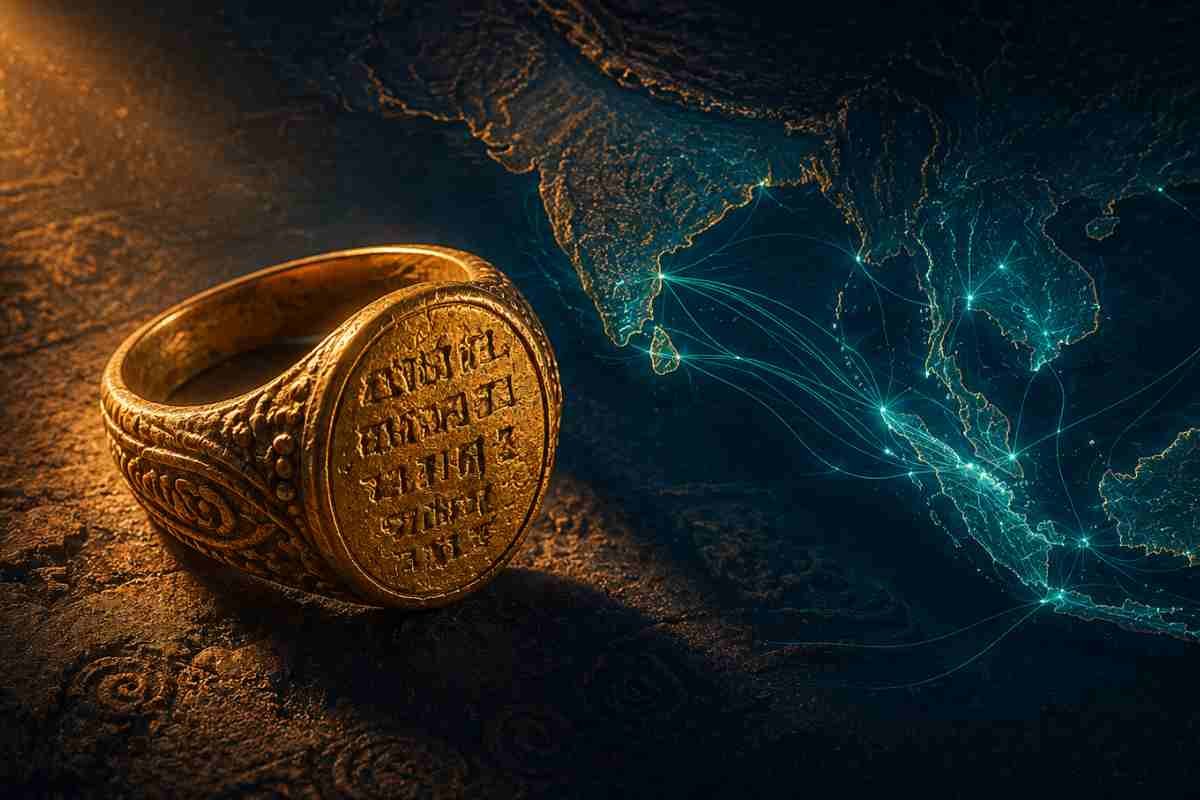
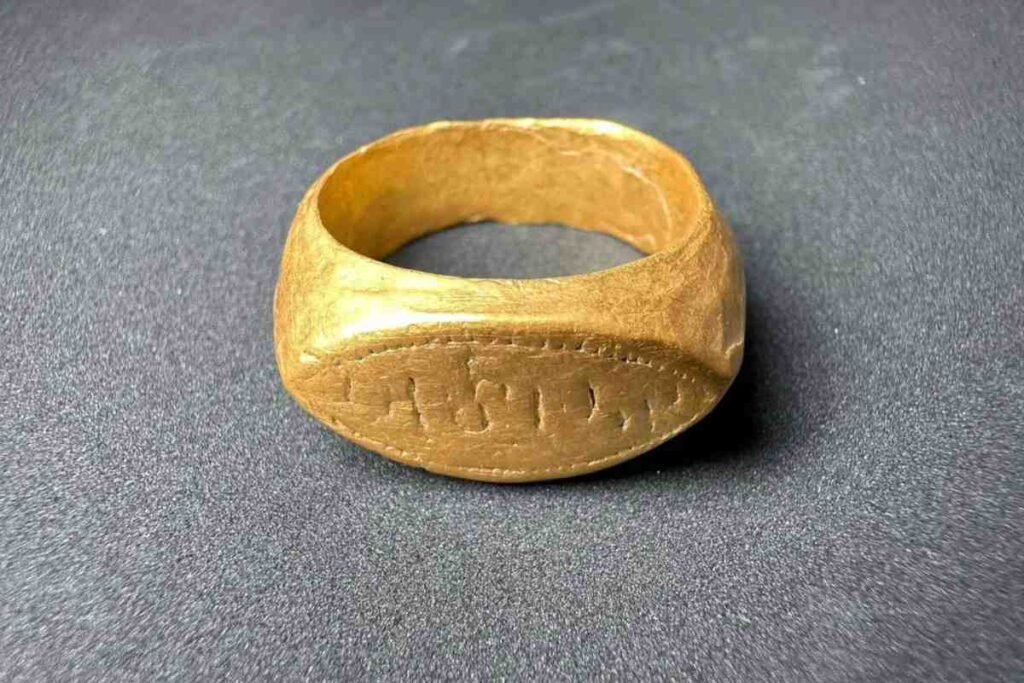
A tiny gold ring, buried 2,000 years ago in a Thai rice field, carries four Sanskrit words in Brahmi script — and it just rewrote what we thought we knew about ancient India’s reach.
Picture a farmer turning soil in a rice field somewhere in southern Thailand. Beneath the earth, unremarkable and patient, sits a small gold ring no wider than a thumb. It has been waiting there for roughly two millennia, through monsoons and kingdoms and the entire arc of what we call history. When archaeologists finally examined it closely, they found something that stopped the room: four words inscribed in Brahmi script, the ancestor of nearly every South and Southeast Asian writing system alive today. The words form a Sanskrit phrase. The ring was not made in India. But India was unmistakably inside it.
This discovery, unearthed at the ancient port site of Khao Sam Kaeo in the Chumphon province of Thailand — a site that scholars now believe was a critical node in early maritime trade — does not simply add a footnote to history. It tears open a much larger question about what ancient Indian civilisation actually was. Not a country. Not a government. A transmission system. A living, breathing cultural architecture that moved across oceans long before anyone drew borders on a map.
When Culture Travels Faster Than Armies
The Brahmi-inscribed gold ring belongs to a category of artefacts that archaeologists call “prestige objects” — items whose value was not purely material but deeply social and symbolic. To wear or carry such a ring in 200 BCE in coastal Thailand was to signal something. Literacy in a specific script. Familiarity with Sanskrit. Participation in a cosmopolitan world where Indian traders, monks, and navigators were not exotic visitors but trusted, recurring presences.
What makes the Khao Sam Kaeo site particularly striking is its profile. Excavations there have previously recovered Roman glass beads, tin ingots, and carnelian stones shaped in distinctly Indian styles. The site appears to have been a multi-ethnic, multi-origin workshop and trading hub — what we might today call a special economic zone, except the currency being exchanged was not just goods. It was knowledge, aesthetic language, and cosmological frameworks. The ring was likely worn by someone who understood what Sanskrit words meant in the context of astrology or ritual protection, two domains where ancient Indian thought held enormous prestige across maritime Asia.
This is the critical systems insight: India did not expand through conquest in Southeast Asia the way Rome did in Europe or the way Mongols swept across Central Asia. Indian civilisational reach operated more like a software upgrade. Local elites across what is now Thailand, Cambodia, Vietnam, and Indonesia voluntarily adopted Indian scripts, Sanskrit names, Hindu and Buddhist theological frameworks, and astrological systems — because these tools gave them administrative power, cosmic legitimacy, and access to a prosperous trading network simultaneously. The gold ring is not evidence of Indian colonisation. It is evidence of Indian cultural gravity.
What the Ring Reveals About the Infrastructure Beneath the Surface
The four Sanskrit words on the ring have not yet been fully published in translated form as of the latest available research context, but epigraphers working on the inscription suggest the phrase relates to auspiciousness or protective benediction — a common use of Sanskrit in personal ornaments across the ancient Indian world. This matters because it tells us the ring was not a diplomatic gift or a merchant’s seal. It was personal. Intimate. Someone chose to carry Sanskrit on their body, close to their skin, as a statement of identity and protection.
That behavioural detail is worth sitting with. It means Sanskrit was not just a bureaucratic language or a trade lingua franca in ancient Southeast Asia. It had penetrated the private, devotional layer of individual life. That kind of cultural penetration does not happen through commercial exchange alone. It requires sustained human presence — teachers, priests, navigators, healers — people who lived among communities long enough to make their cosmology feel native.
Scholars studying Indianisation in Southeast Asia, a term coined by historian George Coedès in the early twentieth century, have long debated how deliberate or organic this process was. The Khao Sam Kaeo ring nudges the answer firmly toward organic. The site predates many of the formalised Hindu kingdoms of mainland Southeast Asia by several centuries. This means the cultural transmission was happening in the informal economy of human contact long before kings adopted Sanskrit throne names and built temples in the Khmer style. The infrastructure came first. The institutions followed.
This pattern has a striking parallel in how Indian civilisational soft power operates even today. Indian diaspora communities across the Gulf, Southeast Asia, the United Kingdom, and North America function as cultural nodes — not agents of a government policy, but carriers of a living system. Food, film, astrology apps, yoga studios, and Diwali events in London’s financial district are, in their own contemporary register, the same phenomenon as that gold ring in a Thai rice field. The form changes. The underlying transmission logic does not.
Why This Moment Matters for Modern India’s Self-Understanding
India is currently in the middle of a significant national conversation about its own civilisational identity. The debates around historical revisionism, the reframing of India as Bharat, the diplomatic push for “Vishwaguru” status — these are all expressions of a country trying to locate itself within a longer arc of history than the colonial period allows. That project, whatever one thinks of its political dimensions, has a genuine intellectual foundation. And artefacts like this gold ring are part of that foundation.
Here is a concrete data point that reframes the scale of what we are discussing: a 2014 study published in the journal Current Biology analysed ancient DNA from individuals buried at archaeological sites across maritime Southeast Asia and found significant genetic contribution from South Asian populations dating back to the early centuries of the Common Era — precisely the period when sites like Khao Sam Kaeo were active. The migration was not trivial. It was sustained and generationally embedded. Ancient India’s reach into Southeast Asia was not a cultural projection. It was a human fact.
What this suggests for contemporary India is something more nuanced than pride or nostalgia. It suggests that the model of influence India pioneered in antiquity — soft, systemic, voluntarily adopted, rooted in knowledge transfer rather than military force — is actually a historically validated and remarkably durable form of civilisational power. At a moment when India is negotiating its role in a multipolar world, that model deserves serious study rather than rhetorical celebration.
The gold ring did not survive two thousand years in a Thai rice field because someone forced it there. It survived because it meant something to the person who wore it. That is the only kind of influence that ever truly lasts.
What does it mean for modern India’s global identity that its deepest historical reach was built not through empire, but through the quiet gravity of culture — and can that model be consciously revived today?