Table of Contents
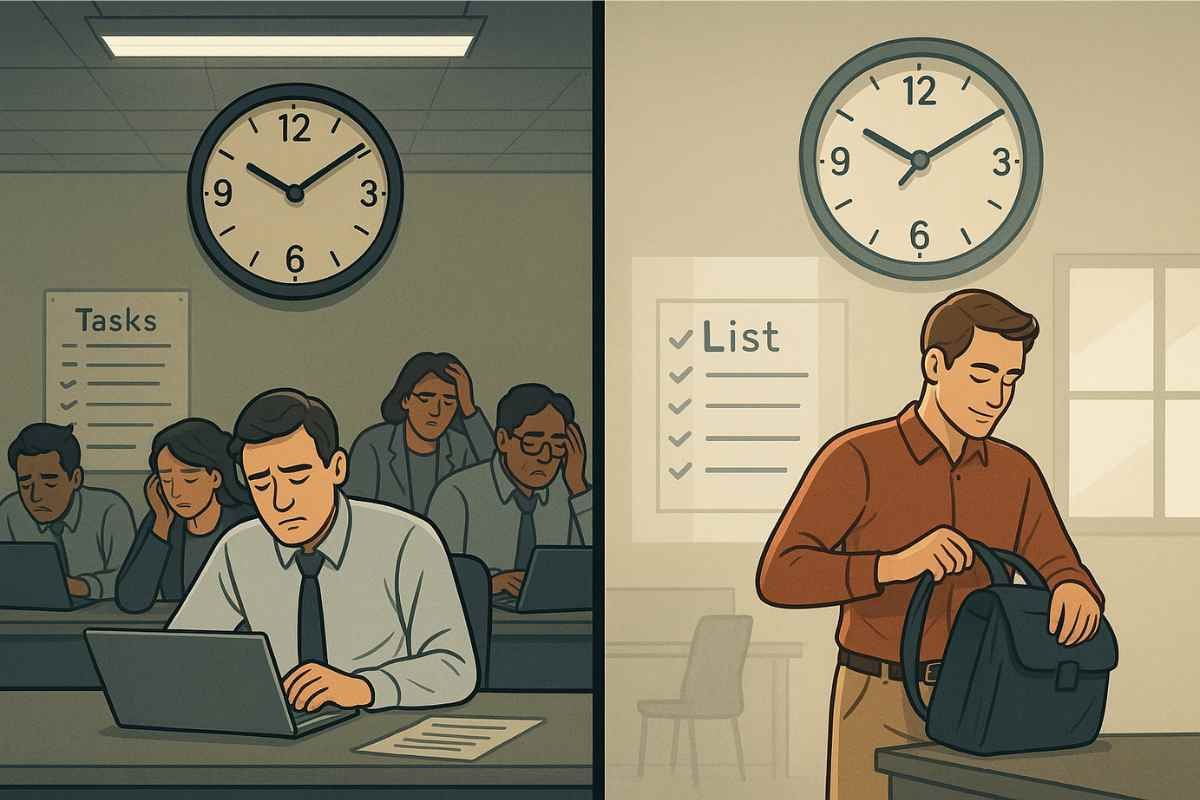
In the pantheon of Indian startup gods, the most revered deity is the one who never sleeps. He’s the founder who proudly posts a 3 AM selfie from the office, the employee whose green dot on Slack is a permanent fixture, the one whose LinkedIn bio reads “Hustler. Grinder. 24/7.” We have created a culture that worships at the altar of overwork. The number of hours logged has become the primary metric for commitment, passion, and loyalty. Leaving the office “on time” is an act of quiet rebellion, often met with side-eyes and silent judgment.
But this hustle worship is a deeply flawed and dangerous religion. It is a perverse incentive system that actively punishes efficiency and rewards performative, often unproductive, busyness. It creates a workforce that is perpetually exhausted, a culture that is riddled with inefficiency, and a business that is sprinting towards burnout, not a sustainable future. This isn’t just a management trend; it’s a cultural virus that masks deep operational flaws and extracts a devastating human toll.
The Cultural Roots of the Grind: “Hard Work” vs. “Smart Work”
Our reverence for the grind is deeply programmed. It’s a legacy of a pre-liberalization India where opportunities were scarce and “sarkari” jobs were prized. In that world, visibility and face-time were crucial for advancement. The employee who stayed late, regardless of output, was seen as the most dedicated. This “work is worship” ethos, rooted in a noble idea of diligence, has been warped in the startup context. We’ve inherited the glorification of “hard work” but have failed to upgrade our operating system to value “smart work” more.
The startup environment, with its high stakes and immense pressure, provides the perfect petri dish for this virus to thrive. The founder, driven by passion and anxiety, sets the tone by working inhuman hours. The early employees, wanting to prove their worth, emulate this behaviour. Soon, it becomes an unspoken rule: the length of your shadow in the evening is the measure of your contribution.
The Perverse Incentive of Inefficiency
When a culture measures commitment by hours worked, it creates a bizarre and counterproductive incentive structure. The most efficient employee, the one who can complete their day’s tasks in six focused hours, is ironically at a disadvantage. If they leave at 5 PM, they risk being seen as a “slacker.” To demonstrate their commitment, they are forced to stretch those six hours of work into ten, filling the remaining time with performative tasks—endless meetings, unnecessary email threads, and simply being “present.”
Conversely, the inefficient employee, the one who is disorganized or lacks focus, is accidentally rewarded. Their inability to complete their work in a reasonable timeframe means they are always in the office late, which is then misinterpreted as heroic dedication. In this system, efficiency is punished, and inefficiency is glorified. It’s a race to the bottom, where the “winner” is the most exhausted, not the most productive.
The Hidden Costs of the Hustle
The damage caused by this culture is immense and often invisible until it’s too late.
- Diminishing Returns & Creative Death: Countless studies have shown that productivity plummets after a certain number of hours. The last two hours of a 12-hour workday are often spent fixing the mistakes made in the previous two. For creative and strategic roles, overwork is a death sentence. You cannot have a breakthrough idea when your brain is running on fumes.
- Talent Repulsion & Burnout: The best, most experienced talent knows their worth. They have lives, families, and hobbies. They are looking for a place where they can make a high impact, not a place that will own their every waking hour. A hustle-first culture will attract grinders in the short term, but it will repel and burn out the A+ players you need to build a lasting company.
- Masking Operational Failures: Glorifying overwork is often a convenient way to avoid asking hard questions. “Why is our team constantly working late?” The hustle culture answer is, “Because we’re passionate and changing the world!” The real answer is often, “Because our product roadmap is unrealistic, our processes are broken, and our management is poor at prioritization.” The hustle becomes a smokescreen for fundamental operational incompetence.
The New Vanguard: Measuring Output, Not Hours
A new, more enlightened generation of founders is actively fighting against this toxic culture. They understand that a startup is a marathon, not a sprint.
Companies like Zerodha and Postman are famous for fostering cultures that respect an employee’s time. They understand that a well-rested, focused engineer who works an 8-hour day is infinitely more valuable than a burnt-out one working 12 hours. They have built cultures based on a simple, revolutionary premise: trust. They trust their employees to get their work done, and they don’t care if it’s done at 2 PM or 10 PM.
They measure success not by the time of the last email sent, but by the quality of the code shipped, the satisfaction of the customer served, and the achievement of clearly defined goals.
Building a Culture of Productive Sanity
Escaping the gravity of hustle worship requires deliberate and courageous leadership.
- Leaders Leave Loudly: The founder and senior leadership must make a visible show of leaving at a reasonable hour. A simple “See you all tomorrow!” at 6 PM is a more powerful cultural signal than any HR policy.
- Define and Measure Output: Shift the conversation from “How long did you work?” to “What did you accomplish?” Implement goal-setting frameworks like OKRs (Objectives and Key Results) that focus the entire company on measurable outcomes.
- Ban the Badges of Busyness: Actively discourage performative work. Kill unnecessary meetings. Don’t reward people for sending late-night emails. Celebrate the team that hits its goals and logs off, not the one that pulls an all-nighter to fix a self-inflicted crisis.
The hustle narrative is a compelling story, but it’s ultimately a destructive one. It’s time for the Indian startup ecosystem to grow up. It’s time to stop worshipping the grind and start celebrating the craft. Let’s build companies that are not just successful, but also sustainable, sane, and fundamentally human.
Have you been a victim of ‘hustle worship’? What’s the one change you think would make the biggest difference in your workplace culture? Share your story.