Table of Contents
In the glowing halls of Bengaluru and Gurugram, the language is of cap tables, burn rates, and blitzscaling. Entrepreneurs, fueled by chai and ambition, chase the hallowed “moksha” of a unicorn valuation or a blockbuster IPO. Their journey is mapped on spreadsheets and pitch decks, a modern scripture of metrics and milestones. But what if the most potent map for their treacherous journey wasn’t coded in Python, but hand-painted on a piece of cloth centuries ago?
What if the original Snakes and Ladders, Moksha Patam, was never just a children’s game, but a sophisticated business ethics curriculum in disguise—an entrepreneur’s indispensable karma map?
This isn’t a whimsical comparison. Before B-schools existed, before Western management theories dominated our boardrooms, Indian merchant communities, particularly the astute Jains and Vaishnavites, had a powerful pedagogical tool. They used Moksha Patam to indoctrinate their children with the core principles of ethical business long before they could decipher a ledger. Each square on this board represented the virtues and vices a trader would face daily.
The ladders weren’t just lucky breaks; they were the tangible rewards of a stellar reputation. The snakes weren’t random misfortunes; they were the inevitable karmic fallout from dishonest gains. This is the story of how ancient spirituality met the earliest cap tables, and its lessons are more relevant today than ever.
The Boardroom, Not the Playroom: Deconstructing the Genius of Moksha Patam
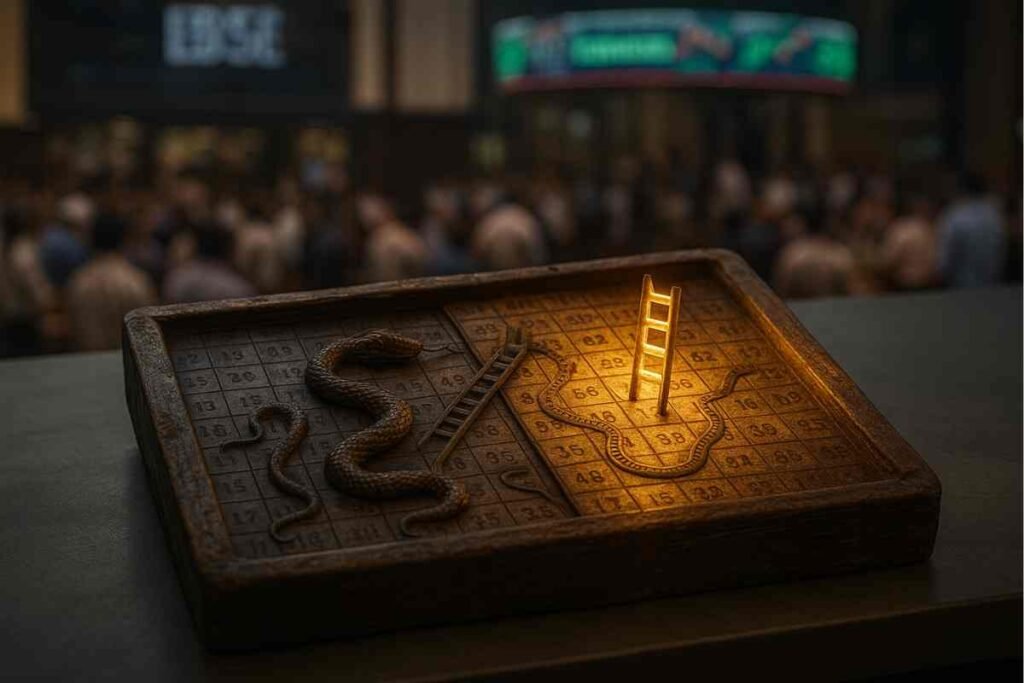
To the uninitiated, especially the colonials who later simplified it into a game of pure chance, Moksha Patam seemed like a simple roll-and-move diversion. This was a profound misreading. The game, also known as Gyan Chaupar (The Game of Knowledge), was a masterclass in philosophy. The 72 (or more) squares were a landscape of human consciousness. You started at birth and aimed for moksha (liberation), the final square.
The ladders were shortcuts, yes, but they always originated from squares of virtue: Shraddha (Faith), Daan (Generosity), Gyaan (Knowledge), and Vinamrata (Humility). The snakes, often more numerous and longer than the ladders, began at squares of vice: Lobha (Greed), Krodh (Anger), Ahankar (Ego), and Kapat (Deceit). The message was crystal clear: your character determines your trajectory. A roll of the dice might give you an opportunity, but it’s the square you land on—the choice you make—that truly dictates your rise or fall.

A handcrafted revival of India’s ancient game of morality and destiny — the original Snakes & Ladders known as Moksha Patam. Beautifully illustrated, it brings together play, philosophy, and heritage — a perfect cultural keepsake or family game night favorite.
Buy on AmazonThe First Gurukul: Training the Bania Brain
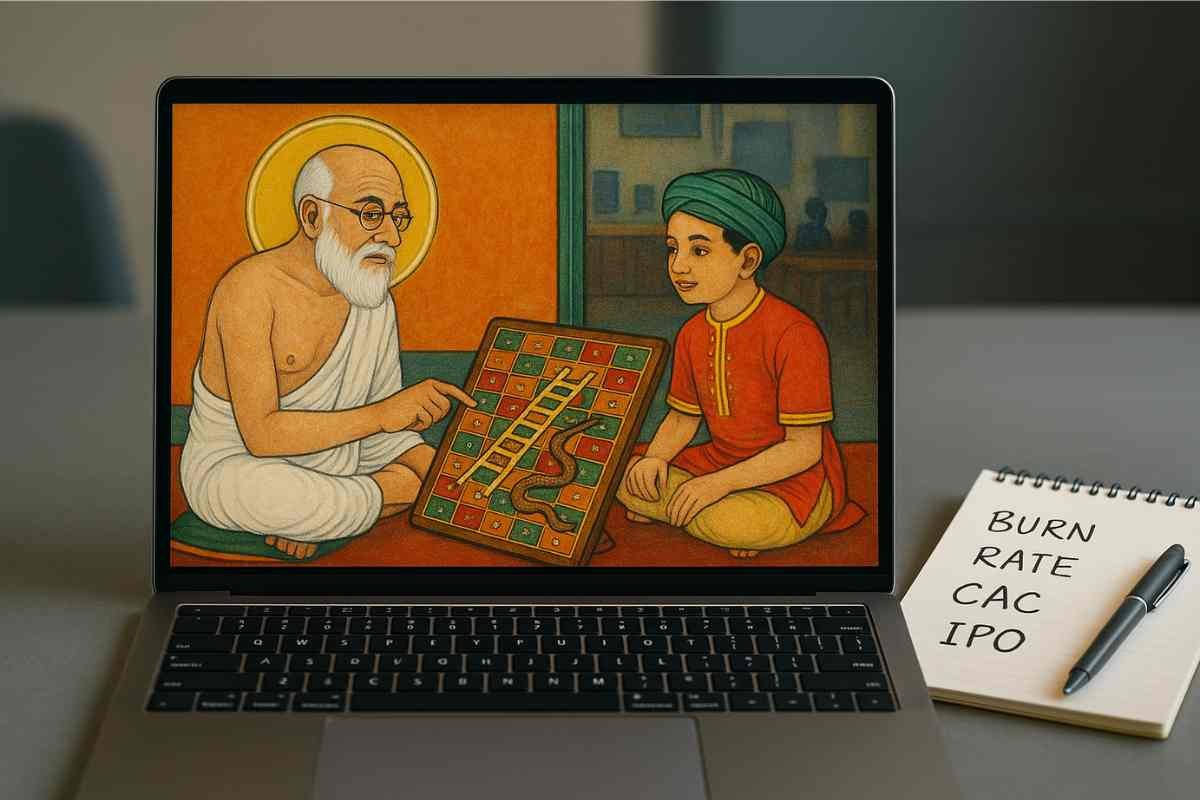
Imagine a young boy in a medieval Marwari or Gujarati household. His father, a shrewd trader whose word (vachan) is his bond across the subcontinent, doesn’t sit him down for a lecture on ethics. Instead, he unrolls the Moksha Patam board.
Here, the boy learns that landing on the square of Honesty (Imaandari) leads to a ladder called Trust (Vishwas), which catapults him far ahead of his competitors. He sees that cutting corners, represented by the square of Deceit, invariably leads to the fangs of a long snake named Ruin (Barbaadi), sending him crashing down. The game visually and viscerally connected abstract virtues to tangible outcomes.
Reputation (saakh) wasn’t just a good thing to have; it was a ladder that let you bypass entire sections of struggle. A bad name was a venomous snake that could swallow your progress in an instant. This wasn’t play; it was simulation. It was the original business case study.
By internalising this karmic map, a child from a merchant community understood the unwritten laws of the marketplace: that sustainable wealth is built on a foundation of trust, and shortcuts born of greed are the surest path to failure. Even today, bringing a modern version like the Moksha Patam Ramayana Board Game into our homes can be a powerful way to instill these foundational values in the next generation, blending timeless stories with priceless life lessons.
The Startup Snakes and Unicorn Ladders of Modern India
Transpose this ancient board onto the landscape of the 21st-century Indian startup ecosystem, and the parallels are uncanny. The journey of an entrepreneur is a real-life game of Moksha Patam, complete with exhilarating climbs and terrifying falls.
The Ladders (Unexpected Climbs):
- The Ladder of Viral Growth: A startup that has painstakingly built a product with real value (Satya) suddenly finds itself the talk of the town. This isn’t luck; it’s the reward for faith and persistence.
- The Ladder of the Anchor Investor: An entrepreneur operating with integrity (Nishta) attracts a marquee investor who not only brings capital but also opens doors, providing a massive leap up the board. This is the ladder of Good Company (Satsang).
- The Ladder of a Strategic Pivot: Facing a dead end, a founder humbly (Vinamrata) accepts that the original idea isn’t working and pivots, only to find a goldmine.
The Snakes (Sudden Falls):
- The Snake of a Funding Winter: A company built on vanity metrics and hype (Maya) suddenly finds the flow of capital turned off. The market demands real substance, and the fall is swift and brutal.
- The Snake of Founder Feuds: Ego (Ahankar) and greed (Lobha) lead to ugly boardroom battles, poisoning the company culture and sending the startup spiraling downwards, often into oblivion.
- The Snake of Regulatory Backlash: A “move fast and break things” approach that flouts the law (Adharma) eventually meets the serpent of government regulation, wiping out valuation overnight.
The strategic depth required to navigate this modern board is immense. It demands the foresight of Chaturanga (chess) and the probabilistic thinking of Pachisi. Games like the epic GoIndia Games Bharata 600 BC Strategy Board Game are not just pastimes; they are training grounds for the mind, teaching the very skills needed to anticipate the snakes and position oneself at the base of a ladder.
Redefining the End Game: Is Moksha Just a Billion-Dollar Exit?
Here lies the most profound lesson of the karma map. In the modern startup world, “moksha” is often narrowly defined as a liquidity event—an IPO, a strategic sale. It’s the destination, the big payout. But in the original game, Moksha was not a destination of material wealth but a state of being—liberation from the endless cycle of desire and rebirth.
Could it be that the true moksha for an entrepreneur isn’t the billion-dollar valuation, but building a business that is sustainable, ethical, and creates lasting value for society? Perhaps it’s about achieving a state where the business runs on principles, not just personalities; where it contributes positively to the world, free from the karmic debt of deceit or exploitation. This is a far more challenging, and ultimately more rewarding, final square to reach. It’s the difference between a fleeting win and a lasting legacy.
Moksha Patam, therefore, challenges us to look beyond the dice roll of market trends and funding fads. It urges us to focus on the squares we occupy—the values we embody. In a world obsessed with growth at all costs, this ancient board game is a quiet but firm reminder that how you play the game is infinitely more important than how quickly you win. It’s a heritage hustle that teaches us that the best businesses are not just built on brilliant ideas, but on good karma.
Is your business climbing a ladder of virtue or flirting with the fangs of a snake? Reflect on this ancient wisdom and share this article on LinkedIn and WhatsApp. Let’s reclaim our heritage as a playbook for modern success. Grab a board like the beautiful, traditional [Enchantoys Parampada Sopanam Cotton Fabric Board Game] and map your own journey. Follow IndiLogs.com for more deep dives into the soul of Indian enterprise!